July 24, 1920
A steamship constructed by the Bethlehem Shipbuilding Corporation was launched at the company’s shipyard in the industrial area of Sparrows Point in the Baltimore region. Initially called Bertice, this ship was renamed Buckeye State – the nickname of the state of Ohio – by the time of her launch.
SS Buckeye State was built for the United States Shipping Board (USSB), a federal agency that had been established in 1916 as a corporate subsidiary charged with significantly expanding the number and operational capacities of American merchant ships.
After the United States entered World War I on the side of Allied Powers the following year, USSB created the Emergency Fleet Corporation (EFC) as a construction program to further address the country’s still-massive shipping shortage and ramp up efforts to build more vessels in the short term for the fight against the Central Powers.
The original plan for Buckeye State was to use her for transporting American troops and supplies to Europe to help with military activities there. However, due to the armistice that ended the war in 1918, Buckeye State was converted into a passenger liner instead.
Buckeye State was launched at noontime on a Saturday. The ship’s sponsor at this ceremony was Bertha M. Miller (1886-1978). Her husband Harold B. Miller (1889-1962) was serving at the time as EFC’s assistant manager of construction in Philadelphia.
Buckeye State’s launch took place a little over three months after a vessel called Hawkeye State (the nickname for Iowa) was launched there at the Bethlehem Shipbuilding Corporation’s Sparrows Point shipyard. SS Hawkeye State, just like Buckeye State, had originally been intended to serve as a troopship but – with the United States back on a peacetime footing – was repurposed as a passenger liner.
Both vessels were highlighted in the Nautical Gazette article about the launch of Buckeye State. “The vessel is a sister ship of the Hawkeye State, launched in April,” reported that weekly shipping magazine. “The two ships are the largest ever built in Maryland.” The Nautical Gazette further noted, “The Buckeye State is 533 feet [162.5 meters] long, 72 feet [22 meters] beam and has a depth of 42 feet [12.8 meters] . . . It is expected that the Shipping Board will operate both ships on the Pacific Coast.”
USSB specifically assigned these vessels to the Matson Navigation Company, one of its shipping agents, for use on a monthly rental basis. These ships operated on a Matson Navigation Company route between Baltimore and – via both Havana and the Panama Canal – San Francisco. Buckeye State and Hawkeye State operated as well on the company’s route between San Francisco and Honolulu.
In 1922, USSB began changing the designations of its ships that had been named after states. These ships were renamed after U.S. presidents instead. The name given to Buckeye State in May of that year was President Taft. Ohio native William Howard Taft (1857-1930) served as the 27th president from 1909 to 1913. About 10 months before Buckeye State was renamed after him, Taft was sworn in as the 10th chief justice of the United States. He remains the only person who has been both president and chief justice. (Hawkeye State, incidentally, was renamed President Pierce.)
About three months after her name change, SS President Taft was reassigned by USSB to the Pacific Mail Steamship Company. This vessel – along with the ships called President Cleveland, President Lincoln, President Pierce, and President Wilson – transported passengers as well as cargo on the company’s extensive route starting between San Francisco and Honolulu and then continuing to the Japanese cities of Yokohama and Kobe, followed by Shanghai, Hong Kong, and Manila.
The President Taft was still part of that Pacific Mail Steamship Company route in June 1924 when she came to the rescue of those on board the British vessel Mary Harlock during a fierce storm several hundred miles (kilometers) off the coast of Japan. This lifesaving mission of the President Taft, under the command of Captain Gerrard T. January (1887-1950) was reported a few days by the Australian newspaper Register (based in the city of Adelaide).
This newspaper recounted, “One morning, while the President Taft was about 700 miles [1,126.5 kilometers] from Japan and battling her way towards Yokohama through one of the most terrific storms that had ever lashed the Pacific, an S.O.S. call was wailed out into space by the wireless of the steamer Mary Harlock, in distress and sinking as the result of being battered by the fury of the wind and waves.” The Register further reported, “The position of the Mary Harlock showed her to be 100 miles [160.9 kilometers] from the President Taft. Capt, January, of the Pacific Mail liner, immediately proceeded to the assistance of the stricken ship, and reached her early that same afternoon.”
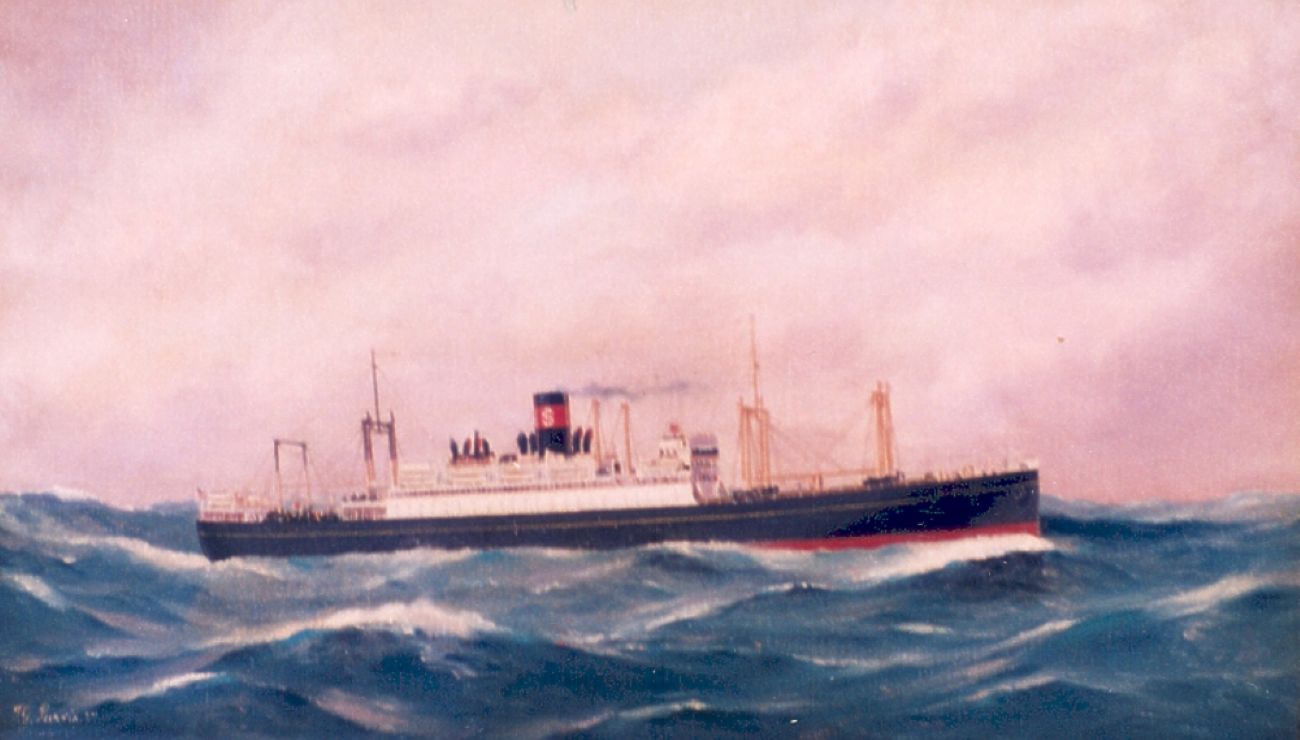
In the spring of the following year, the President Taft was among the ships sold by USSB to the Dollar Steamship Company. The vessel was placed into service on the company’s own transpacific route between California and the Far East. (The attached painting of the President Taft was created by marine artist Thomas G. Purvis [1861-1933] during her time as part of the Dollar Steamship Company’s fleet.)
The President Taft was one of the ships acquired by the United States Maritime Commission in 1938. This independent executive agency subsequently sold the President Taft, along with other ships likewise named after U.S. presidents, to the newly established American President Lines. The President Taft served on that company’s route encompassing New York; the Pacific coast of the United States; and the Far East.
Yet another chapter for the President Taft opened on June 17, 1941, when she was requisitioned from American President Lines by the U.S. Department of War. As U.S. Army Transport (USAT) President Taft, this ship made two trips to Manila via both Hawaii and Guam and completed additional voyages to Hawaii as well as Alaska. In September 1941, the vessel was modified to accommodate even more troops. She was renamed at this time in memory of Major General Willard A. Holbrook (1860-1932), a U.S. Army officer who served for nearly four decades.
During World War II, USAT Willard A. Holbrook was extensively deployed in both the Pacific Theater and the Indian Ocean Campaign for transporting troops and carrying out various other military missions on behalf of the Allies. In 1945, Holbrook was selected for conversion into a hospital ship. When the war ended in September of that year with Japan’s formal surrender to the Allies, however, the plans to refit Holbrook for medical duties were set aside.
In 1948, the War Department transferred Holbrook for layup in the Hudson River in New York and shortly thereafter the ship was moved to the James River Reserve Fleet in Virginia for possible use if ever needed. This vessel’s fate was sealed once and for all when she was sold to the Bethlehem Steel Corporation in 1957 and subsequently scrapped.
Image Credit: Public Domain
For more information on the vessel known as SS Buckeye State at the time of her 1926 launch, please check out https://en.wikipedia.org/wiki/SS_President_Taft


Leave a Reply