Nearly a decade before the official authorization of the U.S. Numbered Highway System nationwide, the state of Wisconsin played a groundbreaking role in the establishment of such routes within its own boundaries.
By 1917, an ever-increasing number of Wisconsin residents recognized the need for changes to be made to state trails and roads that were more of a patchwork of names than a coordinated, easy-to-navigate network of routes for motor vehicles.
Arthur R. Hirst (1881-1932), who had been hired as state highway engineer by the Wisconsin Highway Commission (a precursor to the present-day Wisconsin Department of Transportation) in 1911 and would serve in this position until 1924, gave strong voice to those concerns about the state’s routes. He asserted, “The ordinary trail promoter has seemingly considered that plenty of wind and a few barrels of paint are all that is required to build and maintain a 2,000-mile [3,218.7-kilometer] trail.” (Hirst, incidentally, was president of the American Association of State Highway Officials [AASHO] from December 1918 until December of the following year.)
The statutory mechanism for replacing that frequently jumbled assortment of trail signs with wayfinding route numbers in Wisconsin was a 1917 state law that required the creation of a trunk highway system of up to 5,000 miles (8,046 kilometers). This law included a provision requiring uniform guide and warning signs for that statewide system.
The person who provided pivotal assistance to Hirst in carrying out this ambitious as well as unprecedented project was John T. Donaghey (1867-1933), the state maintenance engineer. Donaghey later expressed his own views on why putting this type of system in place in Wisconsin was so important.
Donaghey recounted, “Previous to its installation, the ordinary method of directing travel was by referring to forks in the road, schoolhouses, red barns, and various other more or less convenient objects. Immediately on the installation of the marking system, all that was necessary was to say, for instance: ‘Take No. 12 until you meet No. 21 and follow 21 to your destination.’” He further noted, “A single, concise sentence, incapable of being misunderstood, took the place of the intricate and incomprehensible descriptions which previously were the only possible method of directing travel.”
One of the potentially more delicate issues that Donaghey anticipated and addressed early on involved the actual numbers to be used for routes in the system. He expressed concerns that assigning the number one only to any of the routes could result in discord among people elsewhere in the state who might see regional favoritism in such a designation. The decision was therefore made not to use the number one on its own – or any of the other single-digit numbers, for that matter – in the new highway network.
The road markers adopted for this system by the Wisconsin Highway Commission were described by the Green Bay Press-Gazette in its edition on April 17, 1918. This article noted, “It is the opinion of those who have examined the standardized system of road marking worked out by State Highway Engineer Hirst that it will give Wisconsin the most thoroughly coordinated system of highway marking in this country.”
The Green Bay Press-Gazette further stated, “There will be 5,000 standard road markers, one on each mile; 1,200 highway intersection signs; 150 county line signs; 500 danger signs; and between 300 or 400 slow or caution signs, 7,000 in all.”
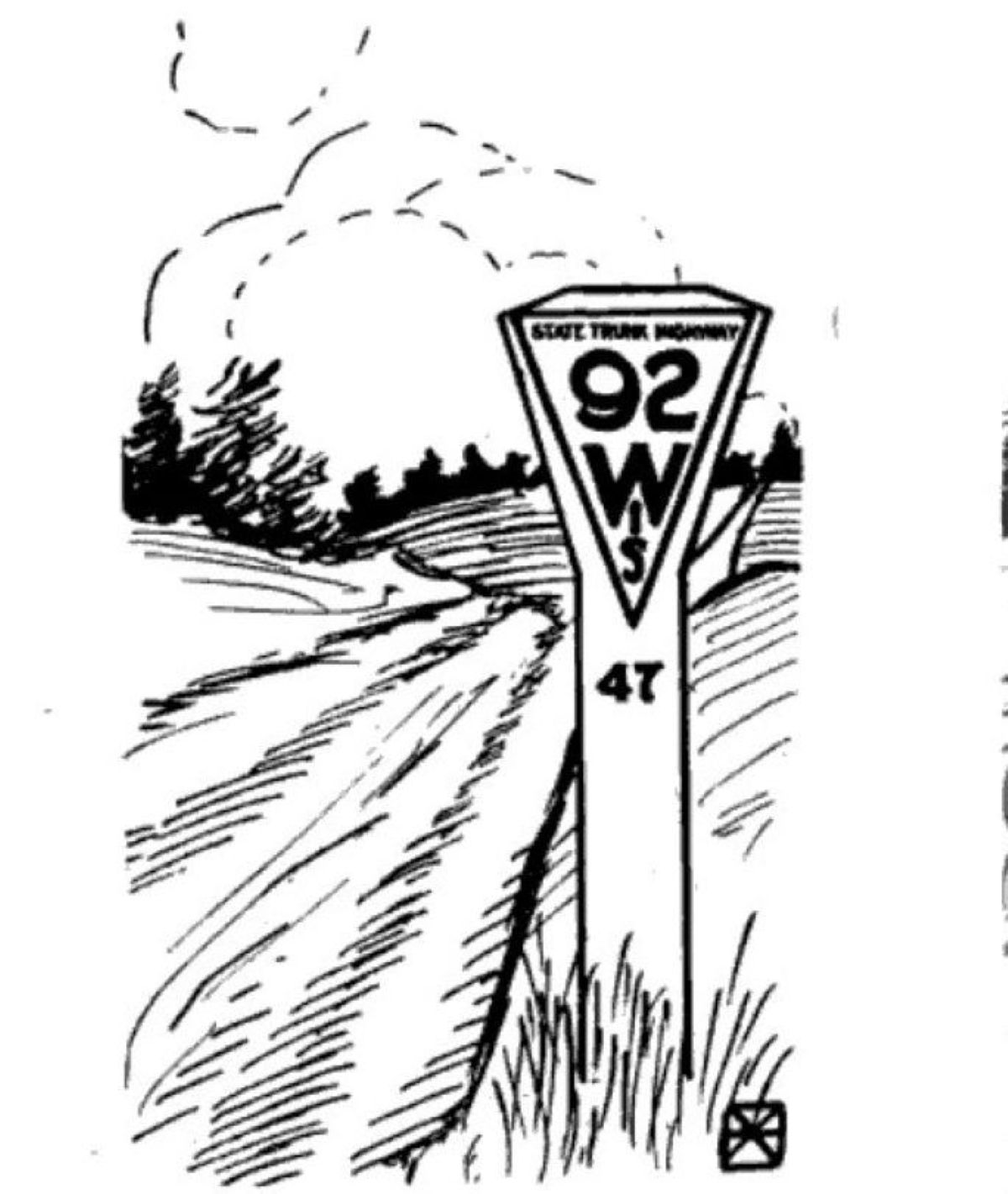
As shown in the attached image appearing in one of the Wisconsin Highway Commission’s 1918 bulletins, each of the standard markers for the system featured a triangular sign with the words “State Trunk Highway” at the top, the route number prominently displayed in the center, and the abbreviation “Wis” included at the pointed bottom.
On May 24, 1918, the simultaneous installation of all the system’s signs across the state was initiated. It took no more than a week for this signage to be fully posted. A few other states subsequently followed Wisconsin’s example when it came to numbering their own routes. Michigan did so by 1919, for example, and Minnesota completed its own efforts in this regard during the 1920-21 timeframe.
A strong case can be made that state-level innovations such as these helped pave the way for the U.S. Numbered Highway System and in particular the resolution approved at the 1924 AASHO Annual Meeting that called for “the Secretary of Agriculture to appoint a joint board to be composed of members of the Bureau of Public Roads and of the State highway departments to cooperate in formulating and promulgating a system of numbering and marking highways of interstate character.”
Image Credit: Wisconsin Highway Commission, Bulletin No. 7, Highway Maintenance Devoted Especially to Patrol Maintenance on the State Highway Truck System (1918), page 8
For more information on the implementation of numbered highways in Wisconsin, please check out https://highways.dot.gov/highway-history/general-highway-history/names-numbers-origins-us-numbered-highway-system and https://wisconsindot.gov/Documents/about-wisdot/research/lib/hc-5.pdf


Leave a Reply