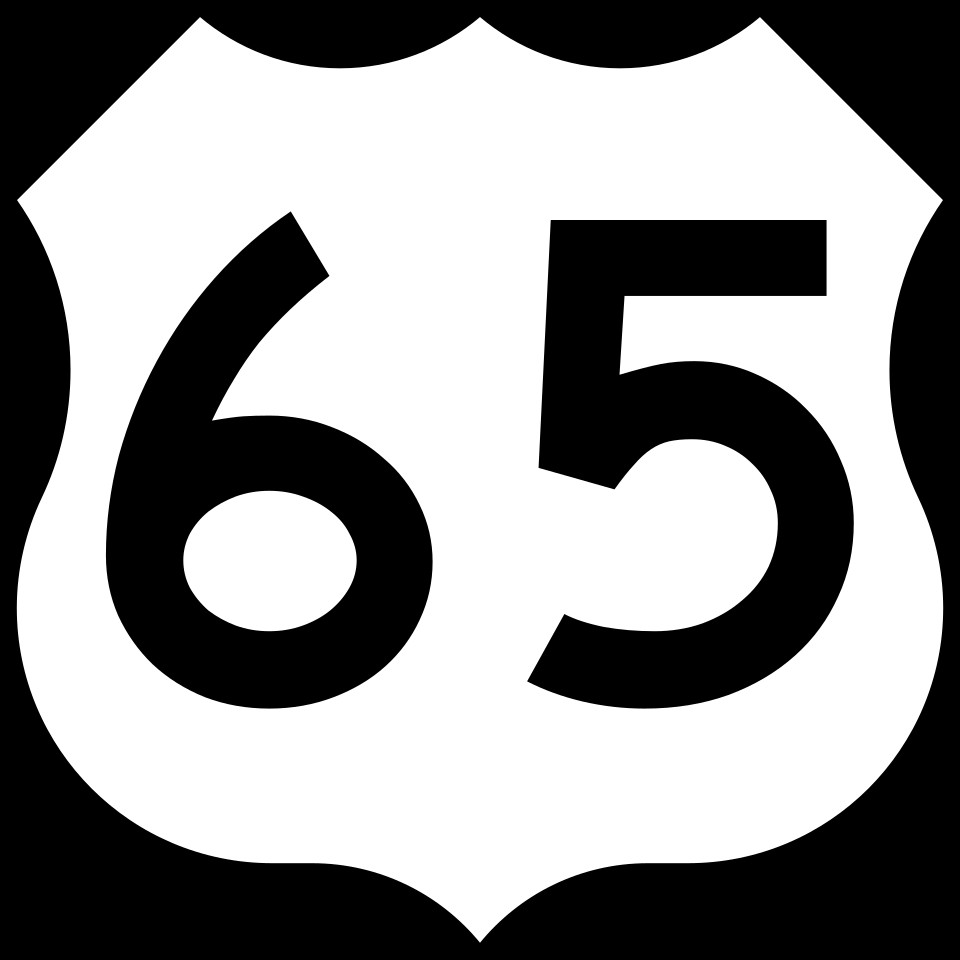
In October 1930, ceremonies were held at the boundary between Iowa and Minnesota to commemorate the completion of the paved section of U.S. Route 65 (US 65) crossing both states. US 65 was one of the routes of the United States United States Numbered Highway System to be approved by the American Association of State Highway Officials (AASHO) in 1926 and formally authorized and announced by the U.S. Bureau of Public Roads early the following year.
As originally designated, US 65 ran from Saint Paul, Minnesota, to the city of Vidalia, Louisiana. The paving of several segments of this north-south route in various parts of Iowa in 1930 were duly marked with considerable fanfare by local communities. The ceremonies that marked the surfacing of US 65 with more durable materials in the vicinity of the Hawkeye State’s border with the North Star State, however, were arguably the most prominent and eagerly awaited of all those commemorations.
In the October 8 edition of the Minneapolis Journal, that large-scale commemoration was called a “paving celebration” in the headline for the newspaper’s article announcing that event. The site for the ceremony was about four miles (6.4 kilometers) north of Northwood, Iowa. Northwood, in turn, was approximately 21 miles (33.8 kilometers) north of Mason City. Located roughly halfway between the Twin Cities of Minneapolis and Saint Paul and Iowa’s capital city of Des Moines, Mason City would take on a significant role in those festivities surrounding US 65.
“Completion of U.S. highway No. 65 in Iowa will mean a continuous concrete road between the Twin Cities and Des Moines,” noted that October 8 edition of the Minneapolis Journal. This newspaper also reported, “A celebration marking the completion of the first paved highway connecting Minnesota and Iowa will be staged October 28 by the Mason City Chamber of Commerce . . . Ceremonies will start at the state line and be continued with a luncheon at Mason City.”
Hundreds of people turned out for the festivities on that last Tuesday of the month. The portion of US 65 in this region had been part of the Jefferson Highway. The event was therefore also an opportunity to pay tribute to that auto trail, which had been established in 1915 and ultimately stretched from the Canadian city of Winnipeg in Manitoba to New Orleans. Mason City resident Hugh H. Shepard (1876-1970), a former president of the Jefferson Highway Association, served as the master of ceremonies on October 28.
A red, white, and blue ribbon festooned across US 65 for the occasion was jointly cut by Governors John Hammill (1875-1936) of Iowa and Thedore Christianson (1883-1948) of Minnesota. Associated Press reported, “The governors also unveiled a bronze tablet, mounted on a concrete monolith, to commemorate the opening of the longest north ad south paving in the middlewest.” The tablet, which is still there today and references the predecessor of US 65 in that part of the world, reads as follows: “This marker, dedicated October 28, 1930 by Minnesota Governor Theodore Christianson and Iowa Governor John Hamill commemorates the completion of the Jefferson Highway across their states.”
In 1935, the section of US 65 in Minnesota was realigned to end in Minneapolis rather than Saint Paul. Minneapolis remained the northern terminus for this highway until 1980, when the route was shortened to end further south in the city of Albert Lea, Minnesota. Consequently, the segment of US 65 in Minnesota covers only 15.5 miles (24.9 kilometers) between Albert Lea and the Iowa state line. Iowa encompasses 238 miles (383 kilometers) of US 65 between the Minnesota and Missouri state lines. The total length of US 65 is now 966 miles (1,555 kilometers) between Albert Lea and the city of Clayton, Louisiana.
Image Credit: Public Domain
Additional information on the 1930 commemoration of US 65 (as well as the Jefferson Highway) at the Iowa-Minnesota border is available at https://streets.mn/2018/04/13/a-history-of-minnesotas-highways-part-three/ and https://www.hmdb.org/m.asp?m=127207


Leave a Reply