November 11, 1926
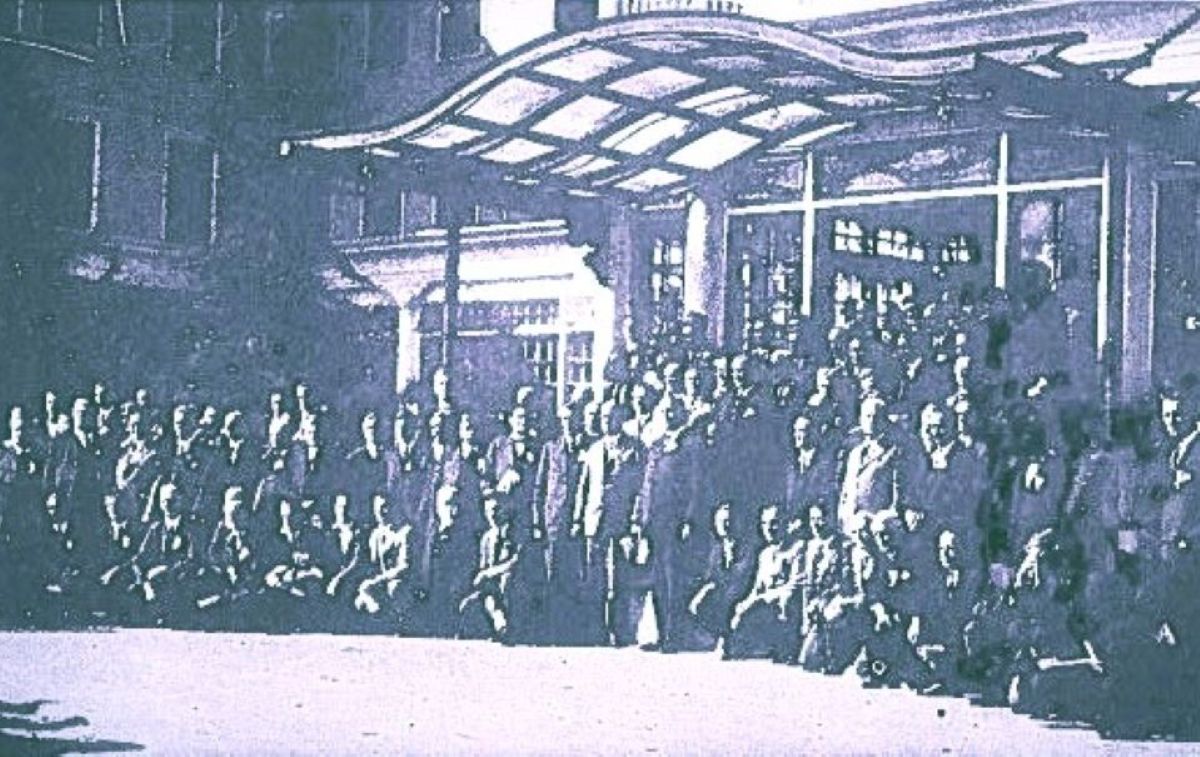
A major transportation milestone took place in the village of Pinehurst, North Carolina, where the annual meeting of the American Association of State Highway Officials (AASHO) was being held. It was at this gathering that AASHO delegates, many of whom are pictured in the accompanying photo taken there in Pinehurst, adopted the routes would form the original version of the United States Numbered Highway System. (AASHO was renamed the American Association of State Highway and Transportation Officials [AASHTO] in 1973.)
The genesis for this pivotal action can be traced to AASHO’s annual meeting two years earlier in San Francisco. This was when the association’s delegates approved a resolution calling for the U.S. secretary of agriculture, as the public official in charge of the department overseeing the U.S. Bureau of Public Roads (BPR) at the time, to work with the states “to undertake immediately the selection and designation of a comprehensive system of through interstate routes and to devise a comprehensive and uniform scheme for designating such routes in such a manner as to give them a conspicuous place among the highways of the country as roads of interstate and national significance.”
The pivotal developments that subsequently unfolded to help make the proposed system a full-fledged reality included the establishment of the Joint Board on Interstate Highways, consisting of state highway officials and BPR representatives, to orchestrate the myriad details for that system; a series of regional meetings held by the board across the country to allow states to weigh in on potential routes; and recommendations for not only assigned numbers for each route but also various uniform signs and markers for all those highways. The final stretch for this wide-ranging process included having the AASHO Executive Committee assess and address proposed additions or other revisions from among the states for the system’s routes that were in play.
One of the key figures throughout all these deliberations regarding the new highway system was Edward Warley (E.W.) James (1877-1967), who served as both the chief of the BPR Division of Design and secretary of the Joint Board on Interstate Highways. Notwithstanding his considerable time and hard work on behalf of shaping the system in its embryonic stage, James showed up at the AASHTO annual meeting in Pinehurst feeling pessimistic about the version of the plan to be submitted there for final approval. He cast aside his nagging frustrations and doubts about this version, however, and ultimately urged that it be given the association’s seal of approval.
“I urge the immediate adoption of the system as now laid out,” James said to his fellow attendees at the meeting. “It is not perfect. After 18 months almost continuous experience with the work I am convinced that to leave the case for further consideration will not improve it . . . We should not announce an opportunity for further revision but adopt the system as nearly as possible as it now comes from the Executive Committee.”
The following month, the New Orleans Daily Journal of Commerce reported on the fledgling U.S. Numbered Highway System and its overall significance. In reporting on AASHO’s adoption of the system, this newspaper confirmed that “public announcement of the exact routes has been withheld until maps could be prepared for distribution.”
The New Orleans Daily Journal of Commerce also addressed the system’s numerical layout and what that would mean for the traveling public. “The route-numbering system which has been decided upon will be of great assistance to tourists in following through routes,” asserted this newspaper. “All east and west routes bear even numbers while north and south routes have odd numbers. Frequently three-digit numbers are used to indicate branches of through routes.”
In addition, the New Orleans Daily Journal of Commerce emphasized what it saw as a few of the other major advantages of these highways. “There will be no change in following any selected route since a standard sign showing the route number has been adopted and also standard caution and directional signs,” noted the newspaper. “These standard signs will add greatly to the safety and convenience as there will be no change in their character in passing from one state to another.”
After the completion of the maps of the U.S. Numbered Highway System, its routes were at long last officially authorized and publicly announced by BPR on New Year’s Day in 1927. Even the initially gloomy E.W. James was eventually won over by the system that made history as the world’s first nationwide network of numbered highways. He stated in 1933 that the “present scheme needs no defense, because it has the merits of being easily extensible to include any reasonable additions,” and that it “has actually accomplished the purpose for which it was created.”
Image Credit: American Highways magazine
For more information on the origins of the U.S. Numbered Highway System, please check out https://www.fhwa.dot.gov/infrastructure/numbers.cfm#a8


Leave a Reply