October 13, 1978
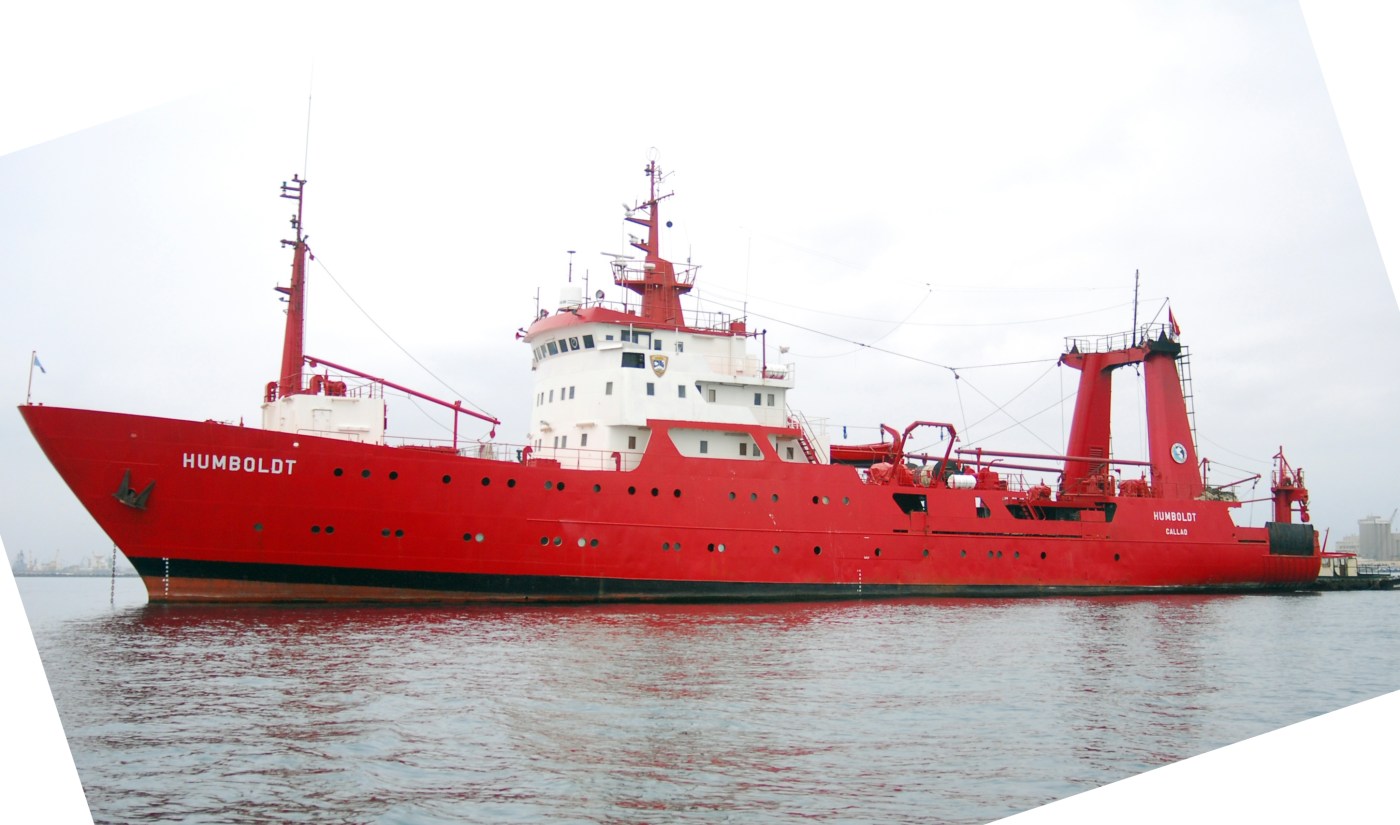
The Peruvian oceanographic research vessel Humboldt was launched. B.I.C Humboldt, which can accommodate about 100 people, was built at Servicios Industriales de la Marina S.A. (Spanish for “Shipyard Marine Industrial Services”) in the seaside city and constitutional province of Callao. (B.I.C. stands for Buque de Investigación, which is Spanish for “Scientific Research Vessel.”) B.I.C. Humboldt was constructed for the Callao-based Peruvian Sea Institute (IMARPE).
This vessel was named after Alexander von Humboldt (1769-1859), a prolific German explorer, geographer, and naturalist. He made seminal contributions to the creation of a quantitative foundation for biogeography and the establishment of geography as a distinct scientific discipline. During his 1802 trip to Peru – known at that time as part of the Spanish provincial district designated as the Viceroyalty of Peru – Humboldt studied the transit of Mercury (the passage of this planet across the Sun) while he was in Callao.
B.I.C. Humboldt has been used over the years for numerous expeditions to the Peruvian research facility called the Machu Picchu Scientific Base. This facility is located on King George Island, which is off the coast of Antarctica, and it was named after an Incan citadel that is on a mountain ridge in southern Peru. B.I.C. Humboldt remains in active service today and continues to be deployed for a wide range of biological, geological, geophysical, and hydrographic research.
Photo Credit: Martin Garcia (https://www.flickr.com/people/14834543@N00) – licensed under the Creative Commons Attribution 2.0 Generic license at https://creativecommons.org/licenses/by/2.0/deed.en
A list of research vessels by country is available at https://en.wikipedia.org/wiki/List_of_research_vessels_by_country
A video about B.I.C. Humboldt can be viewed at https://www.youtube.com/watch?v=Yk4QllFY_rs


Leave a Reply