November 16, 1929
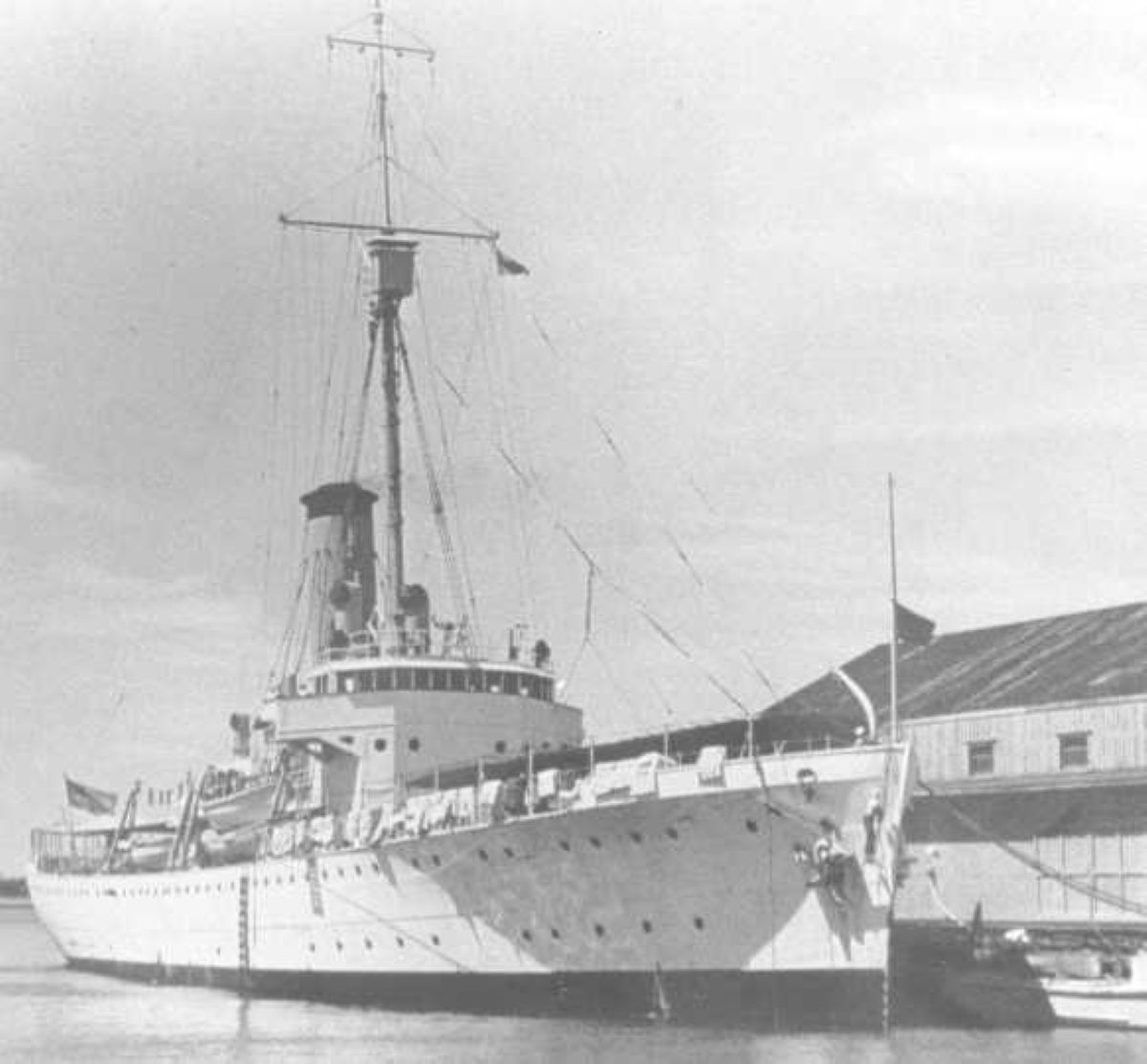
In the San Francisco Bay Area, the U.S. Coast Guard cutter (USCGC) Itasca was launched at the shipyard of the General Engineering & Dry Dock Company that is located at Fifth Street in the city of Oakland. This vessel, which United Press Associations (later renamed United Press International) characterized at the time as the “most modern of Uncle Sam’s coastguard cutters,” was named after Lake Itasca in north-central Minnesota. (That glacial lake is the headwater of the Mississippi River.)
The sponsor of Itasca at her Saturday morning launch was Roberta Jean Lyans (1913-1980), a 16 -year-old resident of the city of Glendale in the Los Angeles area. She had been nominated for the role by Homer Hoch (1879-1949), who served as a U.S. congressman from Kansas between 1919 and 1933. As the sponsor, Lyans broke a bottle of California cider on Itasca’s prow as the cutter slipped down the ways and into the San Francisco Bay Area strait known as the Oakland Estuary.
Itasca was commissioned into the USCG on July 12 of the following year. Over the next few years, this cutter’s duties included conducting patrols in the Bering Sea in the northern Pacific Ocean. In addition, Itasca was used in 1934 to transport the first wave of young men – primarily native residents of the then-territory of Hawaii and other students attending school there – to establish residency on the uninhabited Baker, Howland, and Jarvis Islands in the central Pacific Ocean.
This endeavor was initiated by the U.S. Department of Commerce and called the American Equatorial Islands Colonization Project. The objectives for this project included the installation and maintenance of weather stations and landing fields for American air routes between California and Australia. An additional goal was for the United States to lay claim to those islands as a potential buffer against the ever-growing territorial ambitions of the Empire of Japan in that region of the Pacific. The American Equatorial Islands Colonization Project was expanded in 1937 to also include Canton and Enderbury Islands in the same general area, but this initiative was shut down altogether in the aftermath of the Japanese attack on Pearl Harbor in 1941.
Itasca achieved lasting fame, however, as the “picket ship” in the central Pacific for aviation pioneer Amelia Earhart (born in 1897-declared dead in 1939) and her navigator Fred Noonan (born in 1893-declared dead in 1938) during what turned out to be their ill-fated attempt to fly across the globe in a Lockheed Model 10-E Electra monoplane airliner (also known simply as the Electra).
As a picket ship, Itasca was stationed at Howland Island to provide weather reports and two-radio communication for Earhart and Noonan as they made their way towards that island to land there as a part of the circumnavigation route. Itasca was also used to generate thick puffs of smoke that were meant to serve as visual guidance for Earhart and Noonan to facilitate their planned descent onto Howland Island.
At approximately 8:43 a.m. on July 2, 1937, the last radio transmission from Earhart was received by the crew on board Itasca. After an hour went by without any further contact from the Electra, the crew of the Ithaca took the cutter to the region of the ocean – north of Howland Island — where the final transmission had been made. It was in this area that Itasca was then deployed to begin search operations for the aircraft and both of its passengers. U.S. Navy ships, along with other USCG vessels, soon joined Itasca in these operations. This extensive search effort lasted until being called off on July 16, with the ultimate fates of Earhart and Noonan remaining unknown to this day.
A less appreciated but arguably more positive chapter for Itasca was opened at a point in 1941that predated the United States’ formal entry into World War II on the side of the Allies. After being decommissioned on May 30 of that year, and in accordance with the provisions of the Lend-Lease Act, Itasca was handed over to the United Kingdom for use in this country’s fight against the Axis powers.
As a result of this acquisition, Itasca became part of the Royal Navy and was renamed HMS Gorleston (Y92). Gorleston – officially named Gorleston-on-Sea – is a port town in England’s ceremonial county of Norfolk. Throughout the remainder of the war, HMS Gorleston served extensively as a convoy escort. These convoys traveled on routes traversing such strategically vital areas as the Atlantic Ocean, Mediterranean Sea, Arabian Sea, and Indian Ocean.
Gorleston was returned to the United States on April 13, 1946, nearly eight months after the war ended, and was redesignated as USCGC Itasca. She remained with that uniformed maritime service until being sold for scrap on October 4, 1950. (The accompanying photo of Itasca was taken in 1930.)
Photo Credit: Public Domain
For more information on USCGC Itasca, please check out https://en.wikipedia.org/wiki/USCGC_Itasca_(1929)
Additional information on this vessel’s last radio communications with Amelia Earhart is available at https://www.archives.gov/college-park/highlights/earhart-log


Leave a Reply