June 11, 1764
Operations began for a lighthouse built about 500 feet (150 meters) from the tip of Sandy Hook, a barrier spit located within what was then the British royal colony of New Jersey and at the southern entrance of Lower New York Bay.
This lighthouse had been constructed to help guide mariners traveling to and from the southern part of New York Harbor. The sources for funding the lighthouse were a lottery authorized by the General Assembly of New York (this colony’s legislative body from 1683 until its disbandment just before the start of the American Revolutionary War in 1775); and a tax on all ships entering New York Harbor. Originally known as the New York Lighthouse, this structure was designed by stonemason Isaac Conro (circa 1710-1771). He also supervised the construction of the lighthouse.
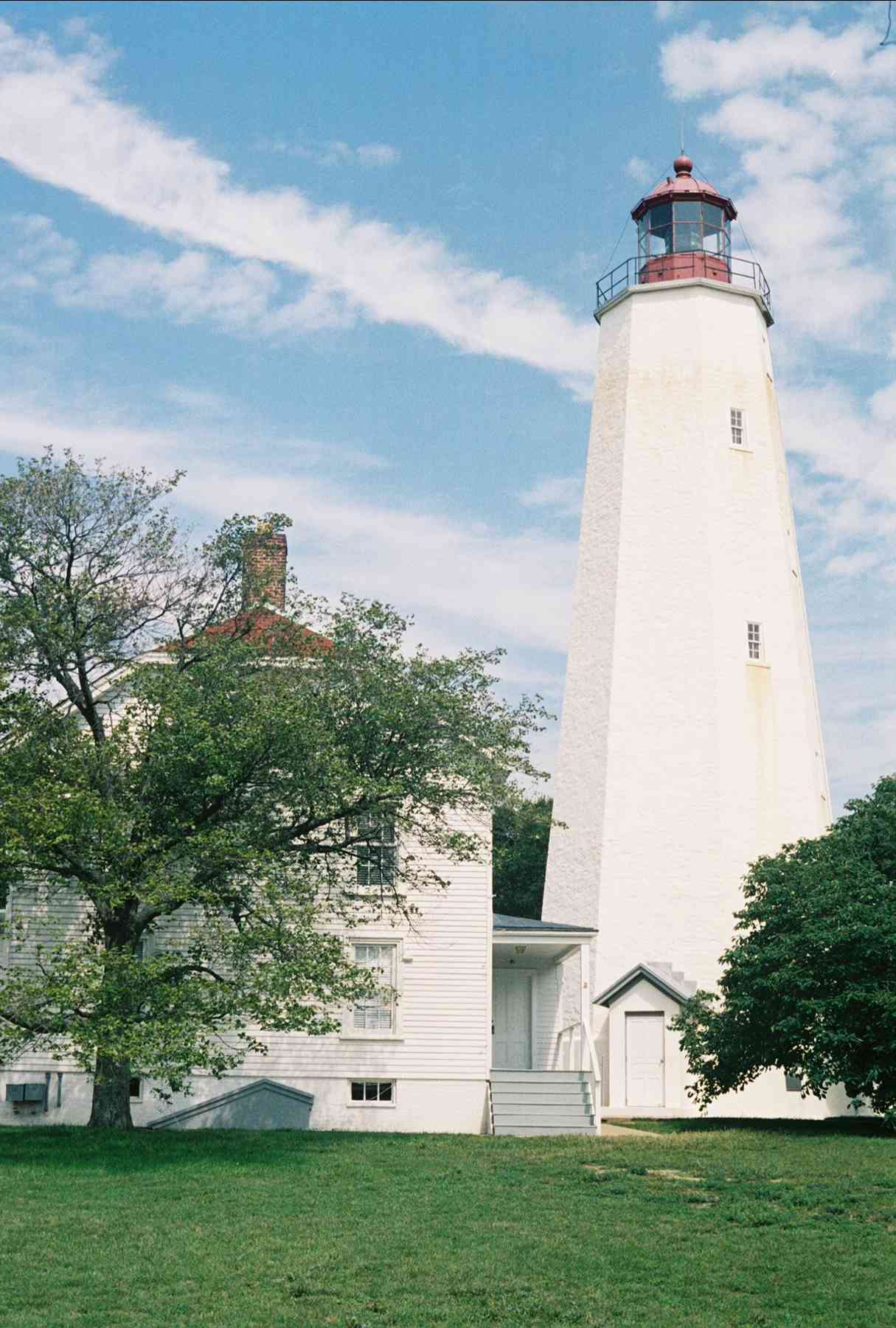
The New York Mercury reported on the lighthouse a week after its inauguration. “On Monday Evening last the New York Lighthouse erected at Sandy Hook was lighted for the first time,” recounted this newspaper. “The House is of an Octagonal Figure, having eight equal sides; the Diameter at the Base is 29 Feet [8.8 meters] and at the top of the Wall 15 Feet [4.6 meters]. The lanthorn is 7 Feet [2.1 meters] high; the circumference 33 Feet [10.1 meters].” The New York Mercury further stated, “The whole constructure of the Lanthorn is Iron; the top covered with copper. There are 48 Oil Blazes. The Building from the surface is Nine Stories; the whole from the Bottom to Top 103 Feet [31.4 meters].”
The lighthouse remained under British control throughout much of the American Revolutionary War, even though Continental Army officer Benjami Tupper (1738-1792) and his troops did make a valiant but ultimately futile attempt to capture this navigational aid and keep it out of enemy hands.
In the years following the end of the war in 1783, a quarrel broke out between New York and New Jersey over which state should have control of the Sandy Hook Lighthouse. This feud was finally extinguished in 1789, when an act of Congress gave control of all lighthouses in the new nation to the federal government.
The Sandy Hook Lighthouse, which has been automated since 1965, holds the record as the oldest existing lighthouse still in operation in the United States. As a result of littoral drift (a geological process involving the movement of sediments along a coastline), the lighthouse is now nearly one-and-a-half miles (2.4 kilometers) from the tip of Sandy Hook.
This lighthouse was listed as a National Historic Landmark in 1964. In 1966, it was added to the National Register of Historic Places. The U.S. Postal Service issued a stamp commemorating the Sandy Hook Lighthouse in 1990. The lighthouse has found its way into the cultural mainstream in other ways as well. In 2009, for example, the Sandy Hook Lighthouse appeared in the final episode of the long-running TV soap opera Guiding Light. The accompanying photo of the lighthouse was taken in 2010 by George E. Leigh (1943-2017), who had served as a commissioned officer at the National Oceanic and Atmospheric Administration (NOAA).
Photo Credit: Public Domain
For more information on the Sandy Hook Lighthouse, please check out https://archives.uslhs.org/places/sandy-hook and https://www.nps.gov/gate/learn/historyculture/shlight250.htm


Leave a comment