June 10, 1822
A historic “first” in maritime transportation took place when the iron steamship Aaron Manby crossed the English Channel from England to France. While there had been crossings of wooden steamships between those countries by this time, the voyage of the Aaron Manby marked the first such voyage of a steamship built of iron. In a far wider context, this crossing of the Aaron Manby also marked the first seagoing voyage of an iron-hulled ship anywhere in the world.
The idea of such a vessel had been conceived by Charles Napier (1786-1860), a captain (later admiral) in the United Kingdom’s Royal Navy (RN). Napier, who would serve in the RN for 60 years altogether, was a farsighted innovator who became focused on steam navigation and the potentially significant advantages of ironclad ships out at sea.
Napier sought to transform his compelling vision of these vessels into reality by working with civil engineer Aaron Manby (1776-1850) to create a seaworthy iron steamship. The pioneering vessel that resulted from their joint efforts was named after Manby, of course. Both men were assisted by Manby’s son Charles Manby (1804-1884) in developing a design for the ship.
The manufacturing of the various parts of the ship took place at the Horseley Ironworks, an industrial plant that was operated by Aaron Manby and based in England’s ceremonial county of Staffordshire. Those components were then transported to the ancient parish (and present-day London district) of Rotherhithe, located along the River Thames, for assembly there.
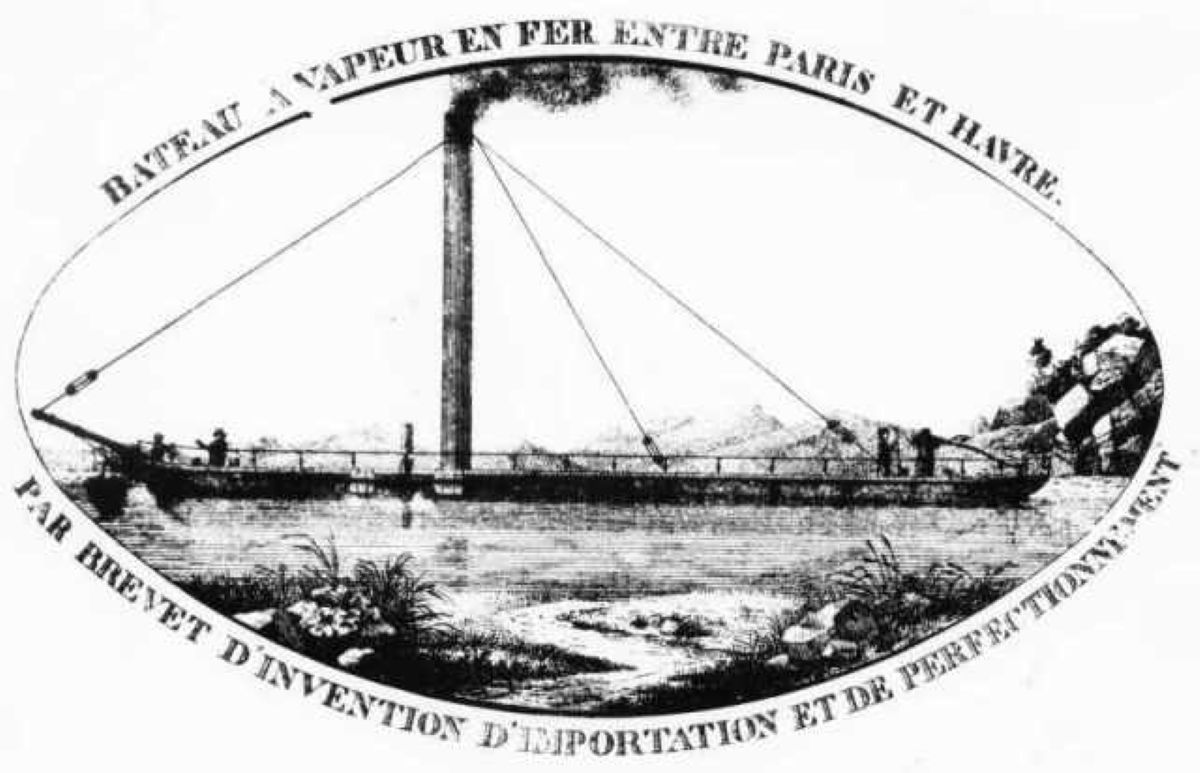
Measuring 120 feet (37 meters) in length, the ship was powered by an oscillating steam engine that Aaron Manby had built and patented. The other key features of this vessel included a flat-bottomed hull made of a quarter-inch (6.4-millimeter)-thick iron plate attached to angle-iron ribs; a 47-foot (14-meter)-tall funnel; and paddlewheels that were 12 feet (3.7 meters) in diameter.
Following several trial runs in England in May 1822, the Aaron Manby finally made her unprecedented trip across the English Channel. Napier served as the ship’s commander for this voyage and Charles Manby was on board to handle engineering duties. The Aaron Manby, traveling at eight knots (9.2 miles, 15 kilometers) per hour, carried both passengers and cargo on this voyage.
After reaching the port city of Le Havre on northwestern France’s mainland, the vessel proceeded up the River Seine to Paris for a rousing welcome there. Following a few more channel crossings, the Aaron Manby was used instead for additional trips on the Seine. Napier ultimately encountered financial setbacks when trying to further pursue his hopes for a fleet of iron steamships, and the Aaron Manby was eventually sold to the French consortium Compagnie des bateaux a vapeur en fer (Iron Steamship Company). This consortium used the vessel for cruises on the River Loire until she was broken up in 1855. (The accompanying image of the Aaron Manby was created sometime around 1825.)
Image Credit: Public Domain
For more information on the iron steamship Aaron Manby, please check out https://www.gracesguide.co.uk/PS_Aaron_Manby


Leave a Reply