June 16, 1941
About six months before the United States officially entered World War II on the side of the Allies, the schooner Bowdoin was commissioned into the U.S. Navy. USS Bowdoin (IX-50) became one of this military branch’s few sail-powered vessels at the time.
Bowdoin was placed under the command of USNR (U.S. Navy Reserve) Lieutenant Commander Donald Baxter MacMillan (1874-1970), the renowned Arctic explorer for whom the schooner had been built two decades earlier. MacMillan received a commission in the USNR in 1925, retiring in 1938 but volunteering for active duty in 1941.
A lifelong New Englander, MacMillan graduated from Bowdoin College in Maine in 1898 with a degree in geology. The schooner bearing the name of his alma mater was constructed at the Hodgdon Brothers Shipyard (now known as Hodgdon Yachts) in the village of East Boothbay, Maine.
It was specifically George I. Hodgdon (1881-1957), a third-generation shipwright, who built Bowdoin at his family’s shipyard. This vessel had been designed for MacMillan by William H. Hand Jr. (1875-1946). Bowdoin had the distinction of being the only American schooner specially made for Arctic exploration.
With MacMillan as the captain, Bowdoin made her first voyage across the Arctic Circle on August 23, 1921. MacMillan eventually used Bowdoin a total of two dozen times to transport students, scientists, and a variety of other people to some of the northernmost regions of the world.
After her commissioning into the Navy, Bowdoin was assigned to join other American military vessels as part of the Greenland Patrol. This operation involved having those vessels undertake various efforts to help protect Allied personnel, equipment, and supplies in Greenland against possible German attacks. In one of her key activities in this regard, Bowdoin was extensively used to survey Greenland’s largely uncharted coastline.
MacMillan served as Bowdoin’s naval commander for just a few months before he was reassigned to work in the Navy’s hydrographic office. By March 1942, USNR Lieutenant Commander (junior grade) Stuart T. Hotchkiss (1913-2001) had assumed command of the vessel.
In May 1943, the Pittsburgh Press reported on Bowdoin’s continued contributions to the war effort. This newspaper noted, “The USS Bowdoin, famous exploration ship now in active service for the Hydrographic Office, cuts through uncharted waters in the Far North while the mean aboard obtain valuable data for navigational purposes. The information is forwarded to Washington for inclusion in new charts.”
In October of that year, Bowdoin was placed in reduced commission. She was decommissioned that December and, in May 1944, struck from the Navy list. This schooner was eventually purchased by friends of MacMillan and refitted for continued use as an Arctic exploration vessel.
In 1959, MacMillan – promoted to rear admiral by a special act of Congress five years earlier – brought Bowdoin to Mystic Seaport in Connecticut for long-term public display there. Over the next several years, though, Bowdoin fell into major disrepair. The Schooner Bowdoin Association, Inc., urged on by MacMillan, acquired the vessel from Mystic Seaport in order to restore her.
The association subsequently leased Bowdoin to Captain Jim Sharp (born in 1933) of Camden, Maine. With a limited budget, Sharp was able to bring the schooner back to operating condition and take her out to sea for charter excursions. He also used Bowdoin as a wharf-side museum there in Camden.
A more comprehensive restoration of Bowdoin took place from 1980 to 1984 at the Maine Maritime Museum in the city of Bath in the Pine Tree State. A couple of years later, Bowdoin was among the vessels that sailed to New York Harbor to participate in the parade of ships celebrating the centennial of the Statue of Liberty. Bowdoin was turned over to the Maine Maritime Academy in Castine, Maine, in 1988. This public college, which is centered around maritime training, continues to serve as the vessel’s home port.
Starting in 1990, Bowdoin has made several trips to points north. An especially notable voyage occurred during the summer of 2024, when the vessel – with Captain Andrew Peacock in command – returned to the Arctic Circle. The schooner crossed the 70th parallel north (the line of latitude that sits 70 degrees north of the Equator) on June 29 and, after covering more than 4,500 miles (7,242.1kilometers) altogether, returned to Castine on August 8.
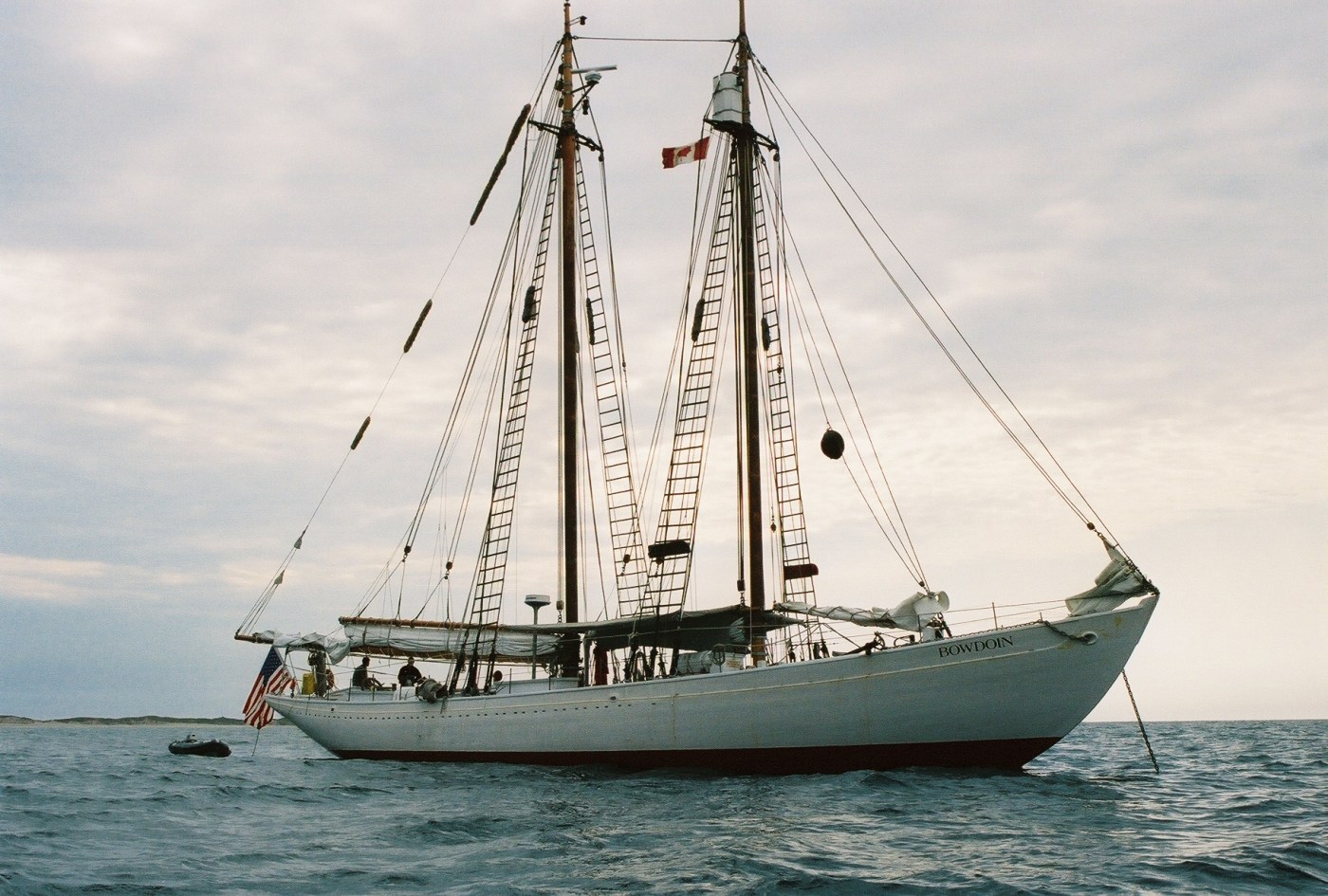
Bowdoin was designated as the official sailing vessel of Maine in 1986. Three years later, she was declared a National Historic Landmark. (The accompanying photo of Bowdoin was taken off Sable Island in the North Atlantic in 2007.)
Photo Credit: Public Domain
For more information on the schooner Bowdoin, please check out https://npgallery.nps.gov/NRHP/GetAsset/NHLS/80000411_text and https://www.bowdoin.edu/arctic-museum/educational-resources/schooner-bowdoin.html


Leave a comment