August 10, 1897
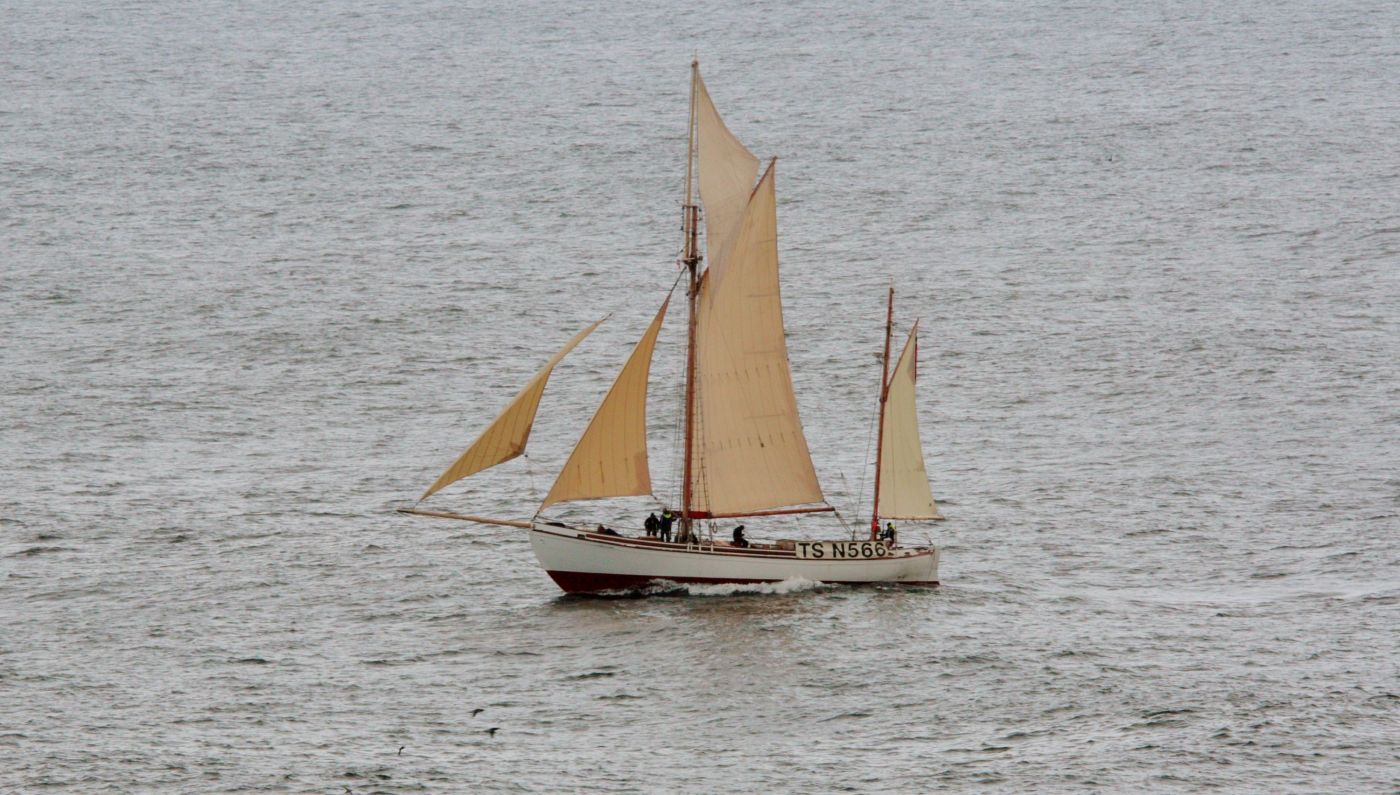
In southeastern Norway, a sailing ship built at the Prosgrund Baatbyggeri shipyard in the municipality of Porsgrunn was launched. (At this time, the present-day kingdom of Norway was part of the United Kingdoms of Sweden and Norway.) The ship was named after the wyvern, a mythical winged reptile that resembles a dragon and has long been popular in heraldry and folklore (not to mention video games).
The ship Wyvern was designed by Norwegian naval architect Colin Archer for Frederick Croft, a British-born timber merchant residing in Norway. Over the next several years, Croft used the vessel on a regular basis for such purposes as voyages to and from his hometown of Hull in northern England.
Starting in 1909, Wyvern was renamed Tatjana and flew under the German rather than Norwegian flag. This ship returned to Norway in 1924, when Norwegian newspaper editor Rolf Thommessen purchased her. He renamed the vessel Havfruen III (Mermaid III).
In 1934, Thommessen sold the ship to someone in England. Havfruen III was acquired 13 years later by Anne and Terrence Carr, an English couple. The Carrs owned the vessel for more than decades, using her for a total of 12 transatlantic voyages and – at some point during the 1950s – a circumnavigation of the globe.
In 1970, the ship was purchased by German economic advisor and lecturer Christian-Friedrich Mattner. He renamed her back to Wyvern. In 1973-74, this vessel was extensively restored at a shipyard in Spain. In an effort initiated by the Norwegian Maritime Museum in Oslo, Wyvern was returned to Norway in 1978 for further restoration. She was handed over to the Stavanger Maritime Museum in the municipality of Stavanger on Norway’s southwestern coast in 1984. Wyvern has since taken part in several sailing regattas, including five tall ship races.
During the 2013 Tall Ships Races from the city of Aarhus, Denmark, to the city of Szczecin, Poland, Wyvern sank between the Swedish islands of Gotland and Öland in the Baltic Sea. All the members of ship’s crew were rescued. Tragically, however, one of the members of the rescue team died. One of three crew members of the Dutch sailing ship Wylde Swan lost his life as well after they went onboard Wyvern to help with rescue efforts. The cause of Wyvern’s sinking was later discovered to be fractures in three keel bolts.
Wyvern was eventually raised from the Baltic Sea and brought back via the ship Island Constructor to Stavanger. Repairs on Wyvern began towards the end of that year at a shipyard in Denmark. Measuring 59 feet and nine inches (18.2 meters) in length, this vessel is still based at the Stavanger Maritime Museum and remains in active service. The accompanying photo of this vessel was taken in 2015 off the coast of the Mainland, the largest of Scotland’s Shetland Islands.
Photo Credit: Ronnie Robertson (https://www.flickr.com/people/16633132@N04) – licensed under the Creative Commons Attribution-Share Alike 2.0 Generic license at https://creativecommons.org/licenses/by-sa/2.0/deed.en
For more information on the sailing ship Wyvern, please check out https://www.stavangermaritimemuseum.no/en/museumsfart%C3%B8yene/wyvern


Leave a Reply