Less than two weeks after the first regional meeting focused on potential U.S. Highway Numbered System routes was held in San Francisco, the second of these meetings took place in a major midwestern hub located on the western edge of Missouri. A few days before this gathering in what is now Missouri’s largest city, the Arizona Republic reported that highway officials from “Mississippi valley states will meet in Kansas City of May 27, to designate the important roads in those states which will be uniformly marked as United States highways.”
This newspaper went into further detail about the planned aims and actions for the meeting. “As a basis for the selection of the routes, each state highway department will present at the meeting a map showing the routes within the state which, in the opinion of the department, should be selected,” noted the Arizona Republic.
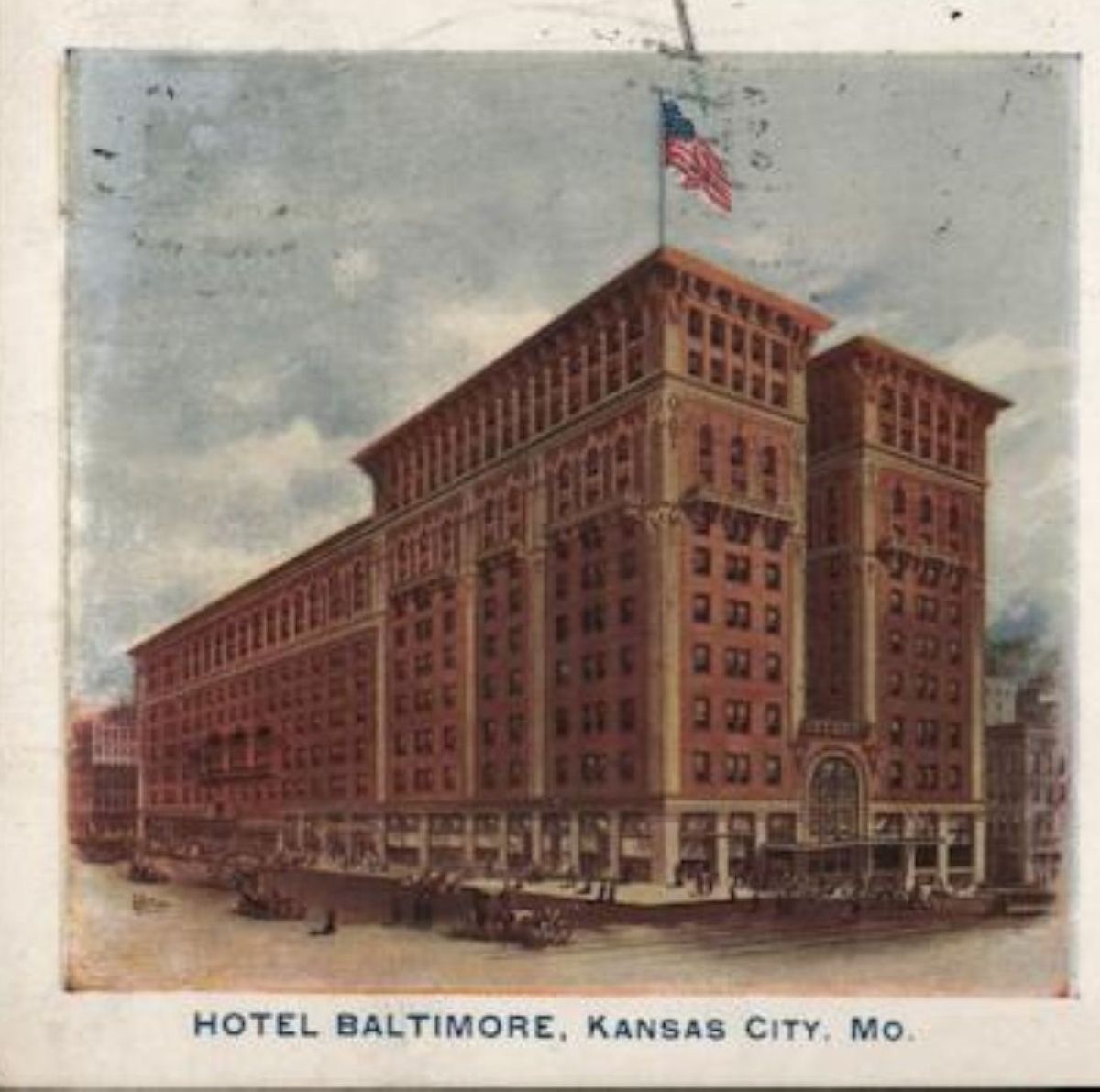
The meeting was held at the Hotel Baltimore. This hotel, which opened in 1899 and would remain in existence until being demolished in 1939, was located at the northeast corner of 12th Street and Baltimore Avenue in the city’s downtown area. (The accompanying postcard image of the hotel was created sometime around 1909.)
The following members of the Joint Board on Interstates Highways attended the May 27 meeting:
- Edward Warley (E.W.) James (1877-1967), who served as both the chief of the Design Division of the U.S. Bureau of Public Roads (BPR) and the board’s secretary;
- Charles Merritt Babcock (1871-1936), Minnesota state highway commissioner;
- Bion Harmon Piepmeier (1885-1974), chief engineer for the Missouri Highway Commission;
- Ormanzo A. Brown (1886-1937), who had recently stepped down as North Dakota state highway commissioner but was still active on the board; and
- Cyrus Avery (1871-1963), chairman of the Oklahoma Department of Highways.
Highway officials from other Mississippi Valley states were present at the meeting by invitation. These individuals included the following:
- Louis D. Blauvelt (1867-1930), state highway engineer for the Colorado Highway Commission;
- Fred R. White (1884-1976), chief engineer for the Iowa State Highway Commission;
- Roy Leroy “Roy” Cochran (1886-1963), state engineer for the Nebraska Department of Public Works (and a future governor of the Cornhusker State);
- Frank V. Lanham (1885-1959), state engineer for the Texas State Highway Commission
- Richard C. Limerick (1892-1958), state highway engineer for the Arkansas State Highway Commission; and
- Walter Van Buck (1889-1984), state highway engineer for the Kansas State Highway Commission.
Even though Wyoming officially counted as a western rather than Mississippi Valley state and had been accordingly represented at the regional meeting in San Francisco, this state’s highway engineer Zina E. Sevison (1884-1964) was likewise present at the Kansas City meeting by invitation. Others attending this meeting were William Colfax Markham (1868-1961), executive secretary of the American Association of State Highway Officials (AASHO); and William H. Lynch (1882-1963), an assistant district engineer for BPR.
In the comprehensive board report submitted later that year to U.S. Secretary of Agriculture William Jardine (1879-1955), the regional meeting in Kansas City was compared favorably to its predecessor in San Francisco. “The meeting was held in parlor D of the Baltimore Hotel and again there was practically complete harmony in the selection of the major routes,” according to the report. “The first choices of adjacent States were not always continuous, but the first and second choices were generally sufficient to secure complete correlation. One adjustment was made by agreement between Iowa and Missouri.”
What truly set this meeting apart from the one in San Francisco, though, was the notably large and evidently unexpected presence of people representing auto trails — routes identified by names rather than numbers — throughout the area. “The meeting at Kansas City appears to have attracted considerable attention among trail organizations and there were between 50 and 60 representatives of various trails in the city to attend the meeting,” recounted the board’s October 1925 report. “Mr. Piepmeier announced that a number had made inquiry of him and he had uniformly advised that it was useless for them to attend as the meeting would be executive in character.”
The report further stated, “There was, however, considerable pressure from these organizations to be heard, some of the delegates had come from Oklahoma and Texas understanding that they would be heard, so the announcement was circulated that if all interested persons could arrange to get together in one place that a brief statement would be made to them regarding the work of the Board, the proposed selection of routes, and the uniform marking.”
The report also outlined what was done next to deal with that sizeable turnout of trail representatives. “Such an informal meeting was held in a room of the hotel other than parlor D where the group meeting occurred, and Mr. James and Mr. Avery, at different times, addressed the representatives of the trail organizations,” noted this report. “The statements made seemed to satisfy these organizations and they very clearly agreed that the work proposed by the Board was entirely satisfactory to them and passed a motion to that effect.”
A couple of days after this meeting, the Kansas City Journal specified what had been discussed and decided upon with respect to proposed routes for that section of the country. “Thirteen or fourteen east and west highways, and from three to five north and south roads, were planned for this section,” reported this newspaper. “Kansas City was made the center of two of the east and west roads, providing a total of seven interstate roads radiating from here, with four connections with St. Louis and Chicago.”
The Kansas City Journal also stated, “The program outlined here will be joined with that of five other conferences in other districts to form the national system.” The next of those five meetings was on track to be held in Chicago on June 3.
Image Credit: Public Domain
For more information on the regional meeting of the Joint Board on Interstate Highways in Kansas City, please check out https://en.wikisource.org/wiki/Report_of_Joint_Board_on_Interstate_Highways_October_30,_1925 and https://www.fhwa.dot.gov/infrastructure/numbers.cfm


Leave a comment