August 7, 1973
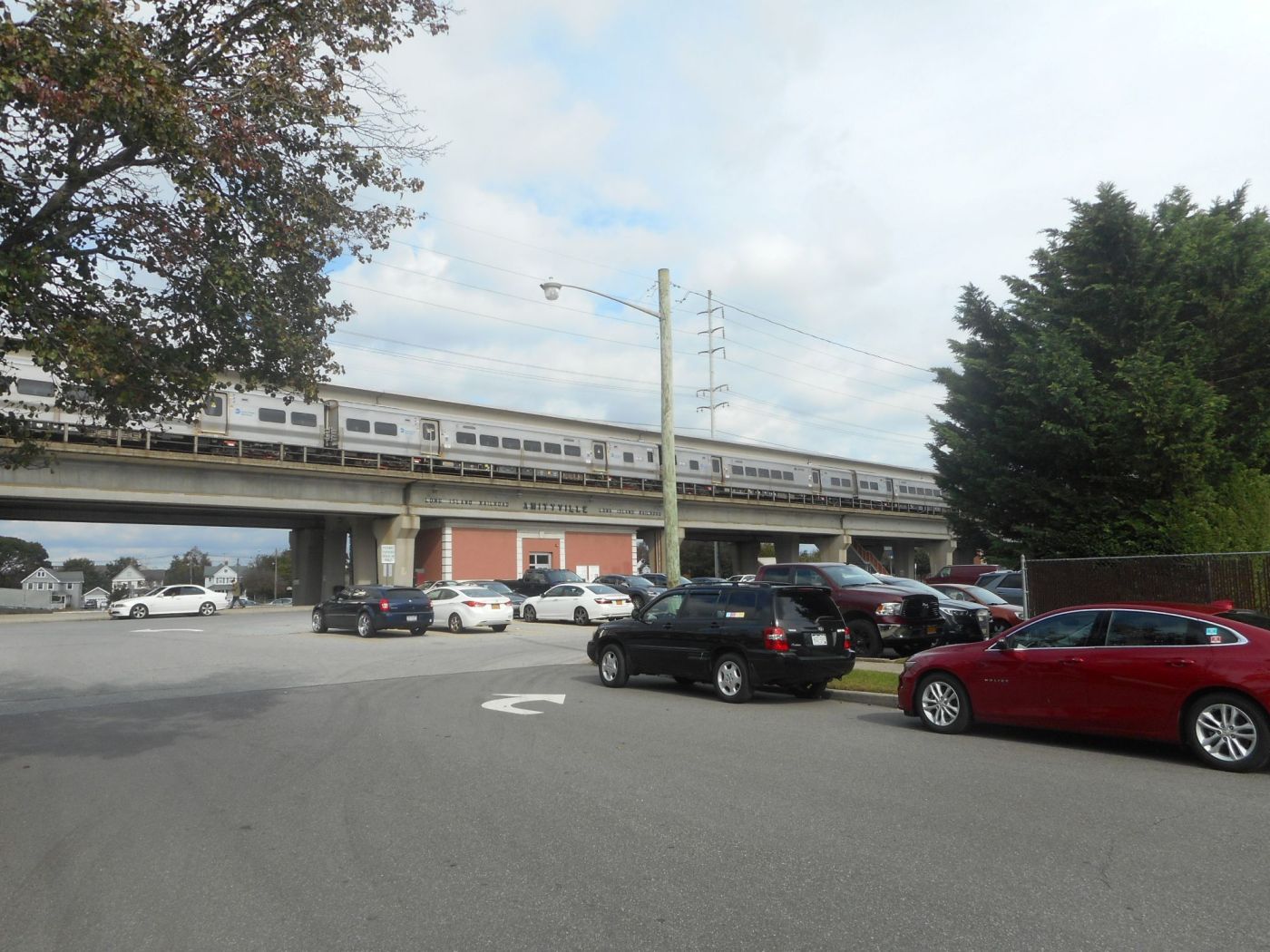
On the south shore of Long Island, a newly built railroad station in the village of Amityville first went into service. Amityville is located mostly in the town of Babylon in Suffolk County; a small portion of the village lies within the town of Oyster Bay in neighboring Nassau County. Amityville station is part of the Babylon Branch of the Long Island Rail Road (LIRR). This structure, as a matter of fact, is that branch’s westernmost station in Suffolk County.
The original version of the Amityville station was a wooden structure that had been built in 1868 by the South Side Railroad of Long Island. This railroad company began operations the previous year as a competitor to LIRR. The South Side Railroad was reorganized in 1874 and leased two years later to LIRR, which entered receivership in 1877. The South Side Railroad of Long Island was eventually reorganized in 1879 as the Brooklyn and Montauk Railroad. This railroad was merged into LIRR in 1889.
That same year, a second version of the station in Amityville was built. (The original structure was moved to a nearby location and continues to exist today as a private residence.) The second version of this station was a brick building that remained in operation until being demolished in 1964. It was replaced by temporary ground-level facilities that stayed intact until being replaced by the third version of the Amityville station in 1973.
This present-day station was constructed as part of a five-mile (8.1-kilometer) stretch of elevated track linking this structure with the LIRR stations in the hamlet of Copiague and village of Lindenhurst (both likewise located within the town of Babylon). Both that segment and the Amityville station were inaugurated on the same date. In an article appearing the next day in the Suffolk County edition of the Daily News, reporter Kevin Lahart characterized those festivities as “a fair-sized celebration” that included a ribbon-cutting ceremony at the Amityville station.
Before that ribbon was cut, however, gold-colored spikes were pounded into a section of the new track that was a half mile (0.8 kilometers) west of the Amityville station. The public officials performing these duties were William Ronan, chairman of New York City’s Metropolitan Transportation Authority; John Klein, Suffolk County Executive; Ralph G. Caso, Nassau County executive; and Raymond T. Schuler, commissioner of the New York State Department of Transportation. At the Amityville station later that morning, as confirmed by Lahart, “coffee and Danish were served to all comers, and the washrooms that normally take a dime to open were left ajar to accommodate visiting dignitaries.”
LIRR in its entirety covers 319 miles (513 kilometers) altogether between Manhattan and — on Long Island — the eastern tip of Suffolk County. The total number of stations within this system is 126. The Babylon Branch, for its part, encompasses 14 stations and approximately 20 miles (32.2 kilometers) within Suffolk and Nassau Counties.
Photo Credit: DanTD (https://commons.wikimedia.org/wiki/User:DanTD) – licensed under the Creative Commons Attribution-Share Alike 4.0 International license at https://creativecommons.org/licenses/by-sa/4.0/deed.en
For more information on the Long Island Rail Road’s Babylon Branch, please check out https://en.wikipedia.org/wiki/Babylon_Branch


Leave a comment