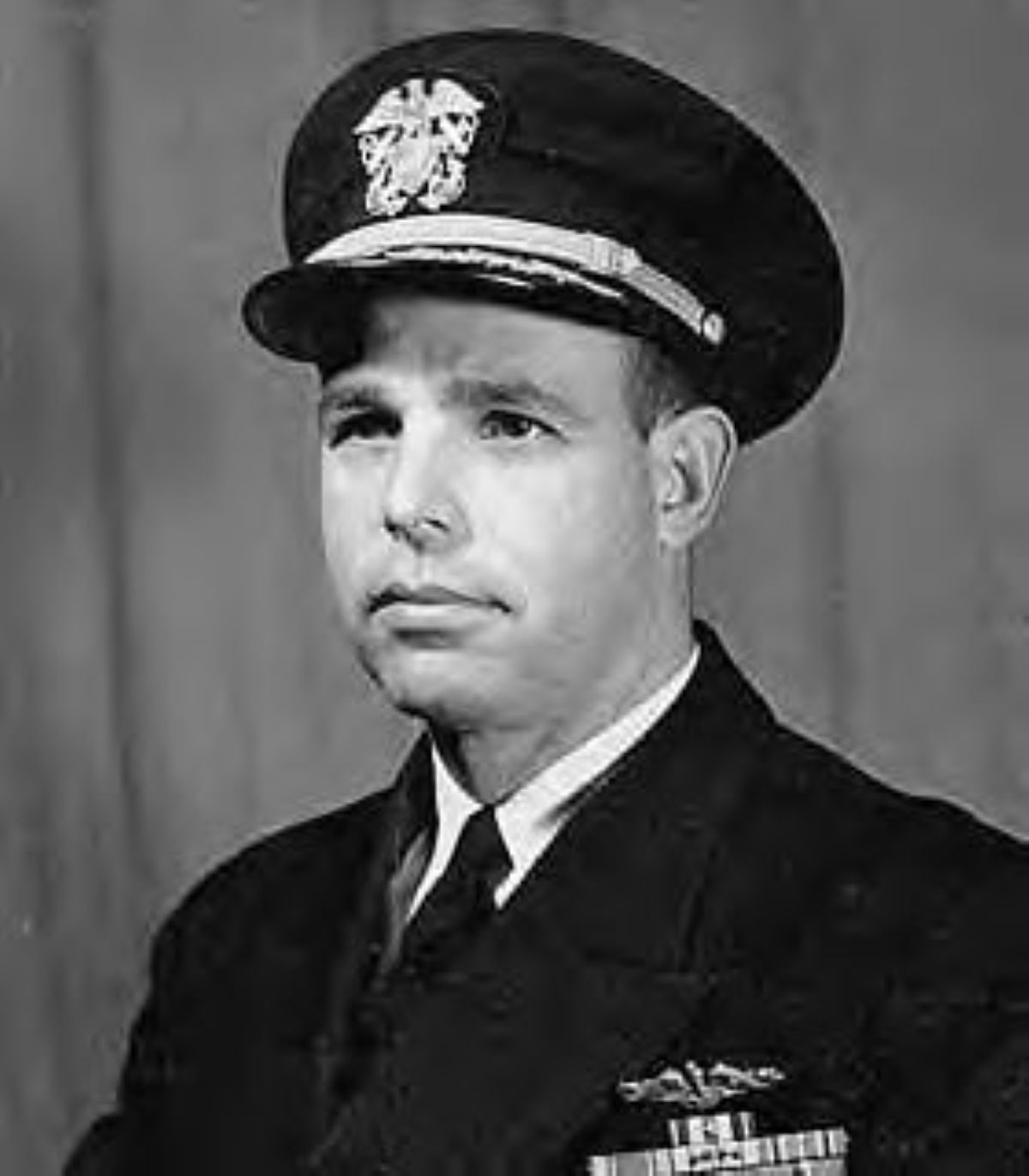
Rafael Celestino Benítez was born on March 9, 1917, in the town of Juncos in east-central part of Puerto Rico. After completing his studies at both George Washington High School and the Army Navy Preparatory School in New York City, Benítez was admitted to the U.S. Naval Academy. He graduated from this institution in 1939 and was assigned to submarine duty.
During World War II, Benítez served aboard the submarines USS Dace (SS-247) and USS Grenadier (SS-210). In 1945, Benítez — a lieutenant commander by this time – was given command of the submarine USS Halibut (SS-232). The following year, he became commanding officer of the submarine USS Trumpetfish (SS-425). Benítez, whose father was a judge, earned his law degree from Georgetown Law School in 1949. That same year, he became commander of the submarine USS Cochino (SS-345).
On August 12, 1949, both Cochino and the submarine USS Tusk (SS-426) departed from Portsmouth, England, for what was reported to be a training mission but later confirmed to be one of the first American undersea spy missions of the Cold War era. By August 25, Cochino was submerged in the waters just above the Arctic Circle and at least 150 miles (241.4 kilometers) off the then-Soviet Union’s port city of Murmansk. It was on this date that one of the submarine’s 4,000-pound (1,814.4-kilogram) batteries caught fire, consequently emitting smoke and hydrogen gas throughout the vessel.
Benítez, unable to get in contact with Tusk, oversaw the firefighting efforts on Cochino. In addition, he had Cochino surface and then instructed dozens of crew members to lash themselves to the deck rails with ropes as protection from the toxic gases while other sailors continued to battle the blaze below. Benítez, however, soon became concerned that strong winds would tear the ropes apart. He therefore ordered 60 sailors who had been bound to the deck rails to collectively instead form a pyramid on the Cochino’s open bridge.
Lieutenant Commander Richard M. Wright, this submarine’s executive officer, was severely burned when he tried to pry open the battery compartment where the fire began. While he managed to survive, civilian sonar expert Robert Philo was not as fortunate. He ended up riding on a raft to get to Tusk and make those on board that submarine aware of what was happening on Cochino. When the raft turned over, though, Philo was knocked unconscious. He was pulled aboard Tusk, but a large wave soon pitched him and 11 others out into the waters. Philo became one of six men lost at sea. He was also the only presumed casualty among those stationed on Cochino.
Even as he sought to sustain the morale of those remaining on Cochino. Benítez focused on maneuvering the submarine into calmer waters and closer to Tusk. That night, Tusk was finally able to get in much closer proximity to Cochino. The fire-damaged vessel’s 76 surviving crew members, including the seriously injured Wright, were able to make their way safely to Tusk via a plank set up between the submarines.
Ultimately, Benítez became the last person still aboard Cochino. When Cochino started to precariously careen back and forth, Benítez crossed the plank with only seconds to spare before it broke apart. Just a couple of minutes later, and 15 hours after the conflagration had begun, Cochino sank in 950 feet (289.6 meters) of water and 100 miles (160.9 kilometers) off the coast of Norway.
Benítez’s subsequent tours of duty in the navy included serving as chief of the U.S. naval mission to Cuba from 1952 to 1954, and commander of the destroyer USS Waldron (DD-699) in 1955. He retired from this military branch in 1959 with the rank of rear admiral.
Benítez went on to get involved with a transportation mode that was markedly different from submarines and other navy vessels. He became an executive at Pan American World Airways (Pan Am) and specifically assumed the role of this airline’s vice president of Latin American services. After working for Pan Am for several years, Benítez taught international law at the University of Miami School of Law. Over the years, he also served this law school in such positions as its associate dean. In addition, Benítez was the founder and director of this institution’s foreign graduate law program.
In his later years, Benítez lived with his wife Nancy in the town of Easton on Maryland’s Eastern Shore. He died there on March 6, 1999, at the age of 81. Benítez was buried with full military honors at Oxford Cemetery in that region of the state. In 2020, he was posthumously inducted into the Puerto Rico Veterans Hall of Fame.
Photo Credit: Public Domain
For more information on Rafael Celestino Benítez, please check out https://en.wikipedia.org/wiki/Rafael_Celestino_Ben%C3%ADtez
Additional information on Hispanics in the U.S. Navy is available at https://en.wikipedia.org/wiki/Hispanics_in_the_United_States_Navy


Leave a Reply