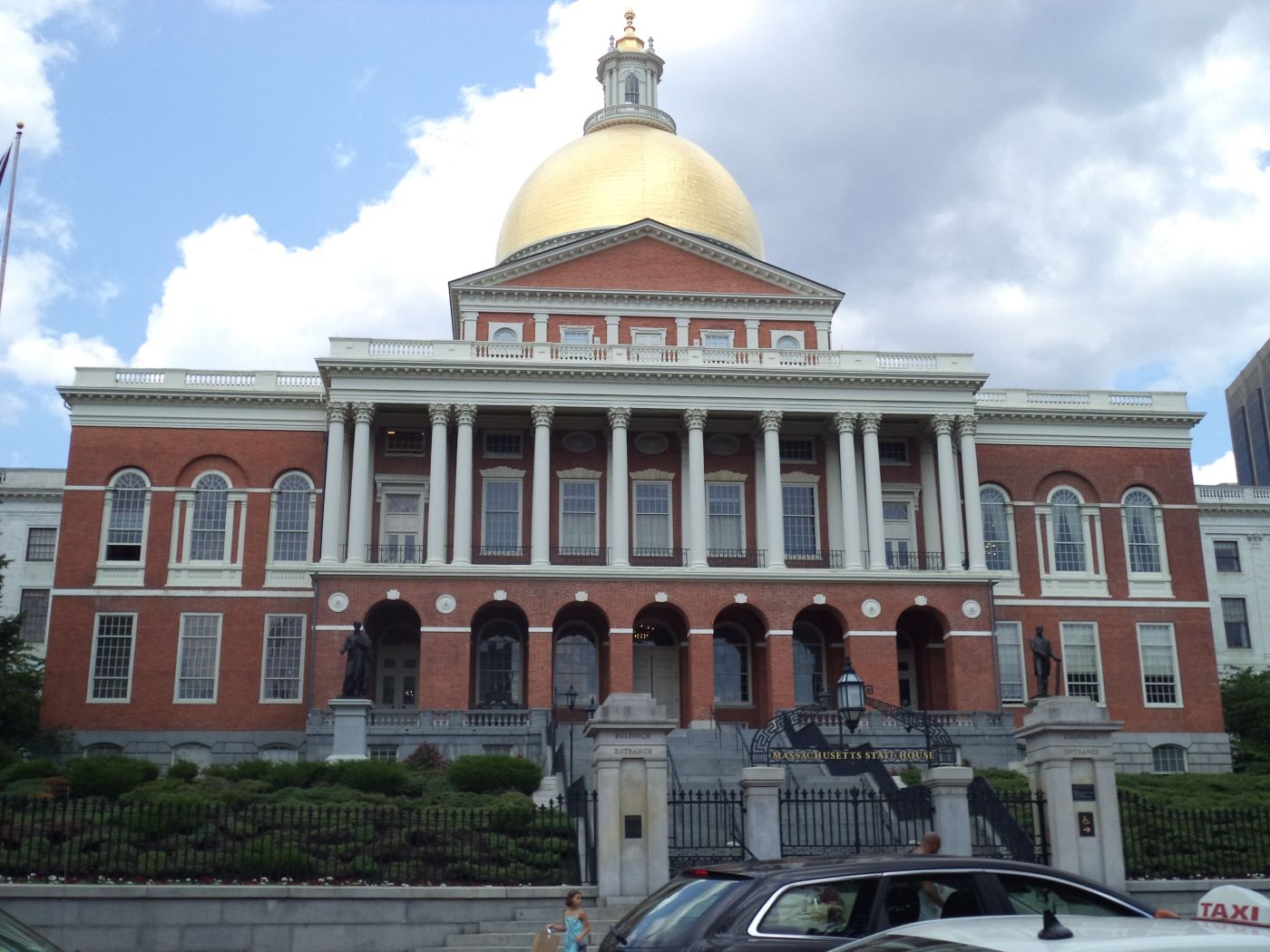
On June 18, 1925, the sixth of the regional meetings of the Joint Board on Interstate Highways was held in Boston for the New England states. The specific location for this gathering was the boardroom of the Massachusetts Department of Public Works in the Massachusetts State House. This building, which was constructed during the 1790s, is in Boston’s Beacon Hill neighborhood. The accompanying photo of the Massachusetts State House was taken in 2014.
“The Boston meeting will be the last of a series of regional meetings held in various centers of the country to select interstate highways and uniform markings,” reported the June 12 edition of the Boston Evening Globe. “A joint committee was appointed in Washington some time ago and the [regional] meetings followed.”
The meeting at Boston started at ten o’clock in the morning of June 18, with the following members of the Joint Board on Interstate Highways in attendance:
- Edward Warley (E.W.) James (1877-1967), who served as both the chief of the Design Division of the U.S. Bureau of Public Roads (BPR) and the board’s secretary;
- William F. Williams (1859-1929), Massachusetts commissioner of public works; and
- John A. MacDonald (1891-1939), Connecticut state highway commissioner.
The following highway officials were present at the meeting by invitation:
- Arthur W. Dean (1870-1952), chief engineer of the Massachusetts Department of Public Works;
- Franklin C. Pillsbury (1869-1937), project engineer for the Massachusetts Department of Public Works;
- George H. Delano (1885-1966), maintenance engineer for the Massachusetts Department of Public Works;
- Paul D. Sargent (1873-1944), chief engineer of the Maine State Highway Commission and a founder of the American Association of State Highway Officials (AASHO);
- Frederic Elwin Everett (1876-1951), New Hampshire state highway commissioner;
- Frederick A. Gardner (1883-1947), an engineer at the New Hampshire State Highway Department; and
- Stoddard B. Bates (1862-1929), Vermont state highway commissioner.
A summary of this meeting was included in the report of the Joint Board on Interstate Highways that BPR chief Thomas H. MacDonald (1881-1957), the board’s chairman, submitted that fall to his boss William Jardin (1879-1955), secretary of the U.S. Department of Agriculture.
“All interstate routes delivered to the New England group were continued without question and entire harmony existed within the group in designating through routes,” noted that summary. “Mr. Sargent of Maine suggested extensions of the present Federal Aid Highway System in his State to make Canadian connections and these are shown on the working map.”
The summary also contained this statement: “There was a general feeling that more routes have been introduced in the country as a whole than should be adopted and in order to make the layout in New England of about the same density as that existing elsewhere in the East, additional roads were inserted within the group, which could be eliminated if necessary on a further consideration of the whole system.”
With the completion of the regional meetings, the stage was now set for the board members to reconvene in the nation’s capital. “’Linking up’ of the recommendations made by those [regional] meetings presents some difficulty,” asserted the Illinois-based Rockford Register Star in an article about that prospective gathering of the full board, “but when it is surmounted the United States will be on its way to the first plan of systematic highway designation ever adopted.”
Photo Credit: Kathy92648 (licensed under the Creative Commons Attribution-Share Alike 3.0 Unported license at https://creativecommons.org/licenses/by-sa/3.0/deed.en)
For more information on the regional meeting of the Joint Board on Interstate Highways in Boston, please check out https://en.wikisource.org/wiki/Report_of_Joint_Board_on_Interstate_Highways_October_30,_1925 and https://www.fhwa.dot.gov/infrastructure/numbers.cfm


Leave a Reply