June 4, 1910
Christopher Cockerell, who would achieve fame as the inventor of the hovercraft, was born in the city of Cambridge, England. He studied mechanical engineering at Peterhouse, a constituent college of the University of Cambridge. Cockerell later pursued studies in both radio and electronics at the University of Cambridge.
In 1935, Cockerell began working for Marconi’s Wireless Telegraph Company in the English city of Chelmsford. This telecommunications and engineering company had been founded by Italian inventor Guglielmo Marconi (1874-1937) in 1897. During his time at the company, Cockerell worked on pioneering technologies such as radio location and radar systems.
After leaving Marconi’s Wireless Telegraph Company, Cockerell bought a small boat and caravan hire business that he eventually named Ripplecraft. With a formidable blend of innovation and entrepreneurship, he started to figure out ways in which vessels such as those that he owned and operated could move even faster. He ultimately realized that, if a small vessel was fully propelled out of the water, this vessel would not be slowed down by any drag and could therefore attain higher speeds.
Cockerell’s epiphany resulted in the creation of the hovercraft. He theorized that, if surrounding air could be channeled to form a “momentum curtain,” this would be make it possible for the amphibious craft to be lifted completely out of the water. Cockerell, using two tin cans and the fan from a vacuum cleaner, tested several designs of his proposed hovercraft. By 1955, he had constructed a workable version of this new means of transportation and filed his first patent for it.
Cockerell, however, subsequently fought an uphill battle trying to interest aircraft and shipbuilding industries in helping to fund and manufacture hovercrafts. Finally, in 1958, the National Research Development Corporation (NRDC) – a government body established by the British government a decade earlier – placed an order with the aerospace and marine engineering company Saunders-Roe Limited to build a prototype of a full-scale hovercraft.
This prototype, which was able to carry up to four people at a speed of 28 miles (45.1 kilometers) per hour, was named the SR.N1 (Saunders-Roe – Nautical One). It was formally introduced to the public on June 11, 1959. After being shipped to France the following month, the SR.N1 successfully crossed the English Channel between the French port city of Calais and the town of Dover, England. That same year, the NRDC established a subsidiary named Hovercraft Development and appointed Cockerell as its technical director.
Cockerell went on to devise numerous improvements to the hovercraft and experiment with various other uses of the air-cushion principle that he had first applied to that vehicle. In 1969, he was knighted for his contributions to engineering. Other honors that were bestowed on Cockerell include the Howard N. Potts Medal in 1965 and the Elmer A. Sperry Award in 1968.
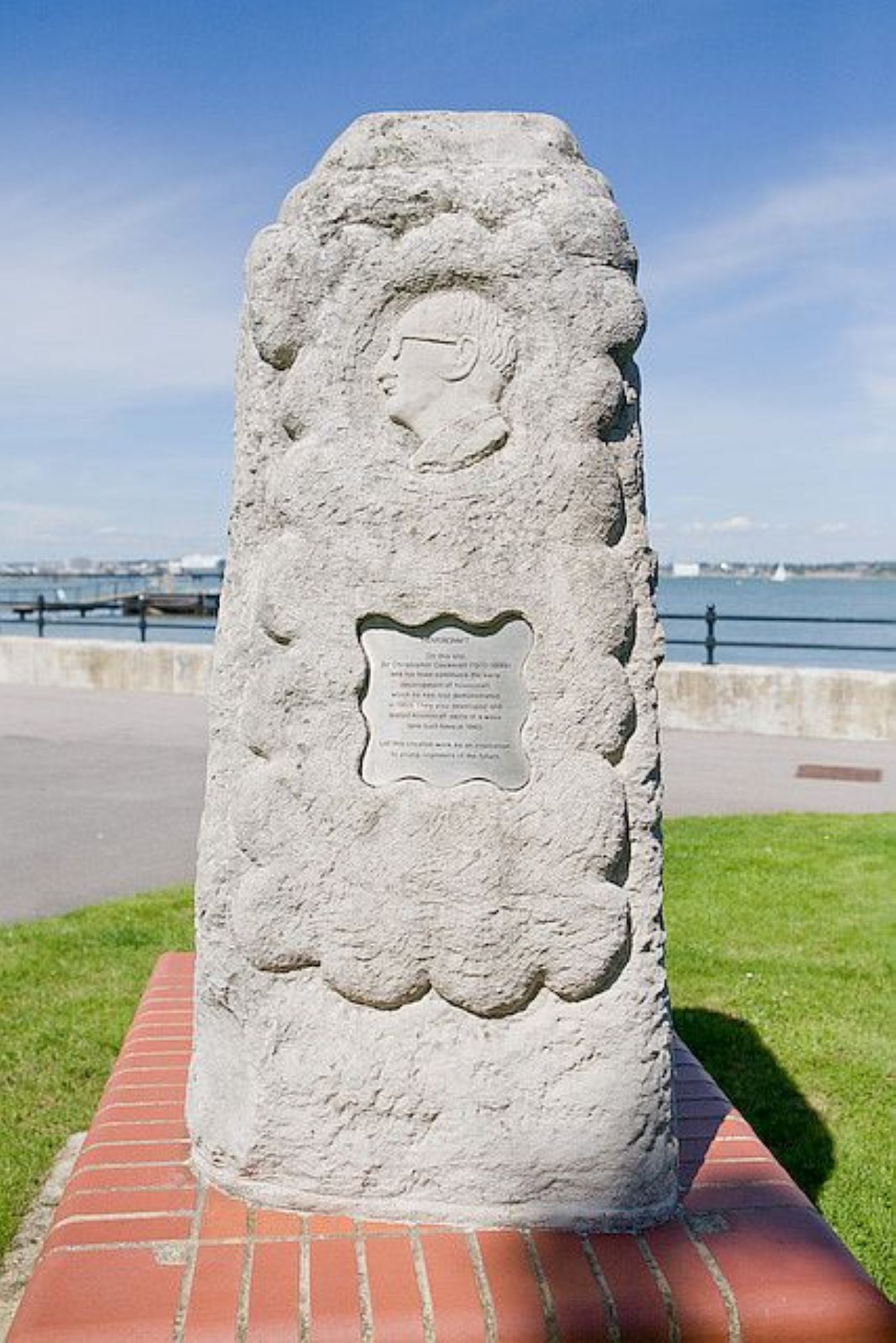
Cockerell died in the English town of Hythe just three days before his 89th birthday. The accompanying photo depicts a memorial to him that is located in Hythe.
Photo Credit: Peter Facey / Memorial to Sir Christopher Cockerell at Hythe / CC BY-SA 2.0
For more information on Christopher Cockerell, please check out https://www.theguardian.com/news/1999/jun/04/guardianobituaries1
A video about him can be viewed at https://www.youtube.com/watch?v=3suXHbw8Nj8


Leave a Reply