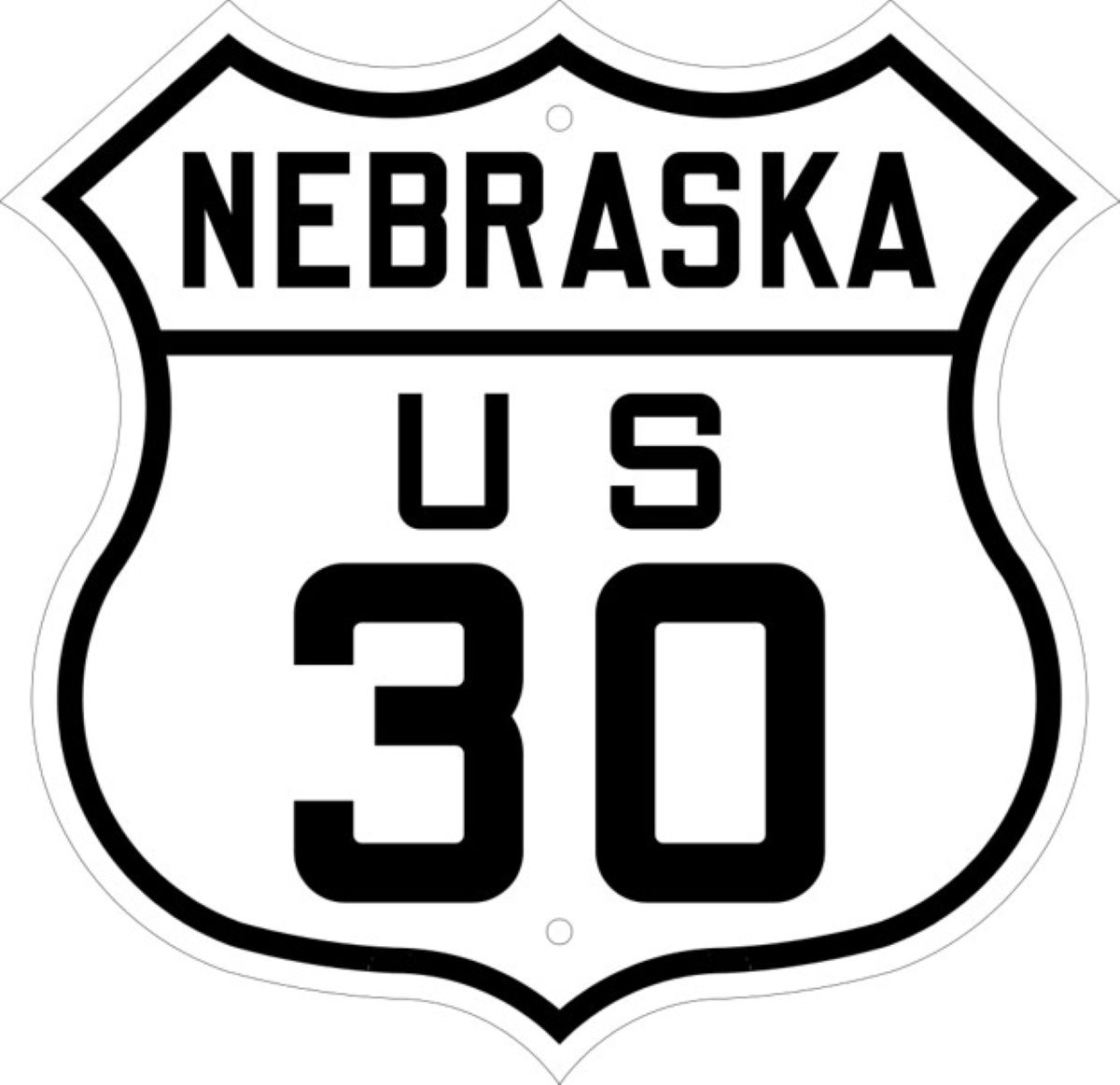
By the fall of 1930, a major milestone took place in Nebraska for the upgrading and opening of the U.S. Numbered Highway System’s transcontinental route designated as U.S. Route 30 (US 30). This milestone involved the finishing touches on a continuously paved segment of that highway from New York City to the city of Columbus in the east-central part of Nebraska.
Those segments of this route in Nebraska that were finally hard-surfaced were a 23-mile (37-kilometer) east-west portion between the community of Ames and the city of Schuyler; and a 17-mile (27.4-kilometer) linking that city with Columbus to the west. These sections helped constitute “Nebraska’s longest stretch of paved highway” at the time, as confirmed by the Omaha Evening Bee-News, and plans were made for the cities and other communities along the former of those segments to celebrate together.
“With an old-fashioned country fair picnic the opening of 23 miles [37 kilometers] of hard surface road between Ames and Schuyler on Federal Highway No. 30, completing 90 miles [144.8 kilometers] between Omaha and Columbus,” according to United Press Associations (UP), that celebration was held on September 26, 1930, in the city of North Bend. This city is approximately eight miles (12.9 kilometers) west of Ames and 15 miles (24.1 kilometers) to the east of Schuyler.
“In celebration of the completion of the paving on U.S. highway No. 30 from New York City as far west as Columbus, representatives of towns along the route gathered here today,” UP further reported from North Bend on the day of the event. “A program starting at 10 a.m., and continuing on through the evening will include speeches, band concerts, drum and bugle concerts and a ball game.”
That Friday’s festivities in North Bend also included a parade through the streets of the city. This parade featured students from various city schools showcasing floats and slogans that they had prepared for the occasion. The baseball game highlighted by UP took place that afternoon, with a team from the local city of Fremont battling a team that consisted of players from clubs in not only both North Bend and Schuyler but also – further to the east and along the state’s boundary with Iowa – the city of Blair.
“North Bend is Prepared for Large Crowds,” announced the previous day’s edition of the Fremont Tribune and, sure enough, a sizeable number of people turned out to help commemorate the opening of one of the newest paved portions of US 30. Those individuals included U.S. Congressman Edgar Howard, who represented that region of Nebraska; and Robert LeRoy “Roy” Cochran, who headed the Nebraska Department of Roads and Irrigation (now part of the Nebraska Department of Transportation) as its state engineer and later became governor of the Cornhusker State.
In addition, a delegation of prominent good roads advocates from Omaha likewise journeyed all the way to North Bend to participate in the celebration. One of these advocates was W.B. Cheek, chairman of the public highways committee of the Omaha Chamber of Commerce. After being formally introduced by James Sloss, president of the North Bend Community Club, Cheek spoke to his numerous fellow attendees about what that day’s festivities meant to him and their overall significance to the history of roads in Nebraska.
“This is the proudest moment of my life,” Cheek asserted. “It is my proudest moment because it is the culmination of nearly 16 years of endeavor.” Cheek went on to declare, “For that many years have I been striving to interest Nebraska in hard paving of our highways, and for nearly that many years have I been frustrated in attracting the attention and interest of Nebraska farmers and townsmen. Now I can see the battle is just about won.”
A little over five years after that celebration in North Bend, the final segment of US 30 within both Nebraska and the entire route nationwide was officially opened in the west-central part of the state. The inauguration of that 34-mile (54.7-kilometer) stretch of US 30 between the city of North Platte and the village of Sutherland made the route the country’s first fully hard-surfaced transcontinental highway.
The present-day alignment of US 30 in Nebraska covers 451.7 miles (727 kilometers) between Blair and – not far from the village of Bushnell – the state’s boundary with Wyoming. US 30 in its entirety now covers a total of 3,112 miles (5,008 kilometers) between Atlantic City, New Jersey, and Astoria, Oregon.
Image Credit: Public Domain
For more information on US 30 in Nebraska, please check out https://en.wikipedia.org/wiki/U.S._Route_30_in_Nebraska


Leave a Reply