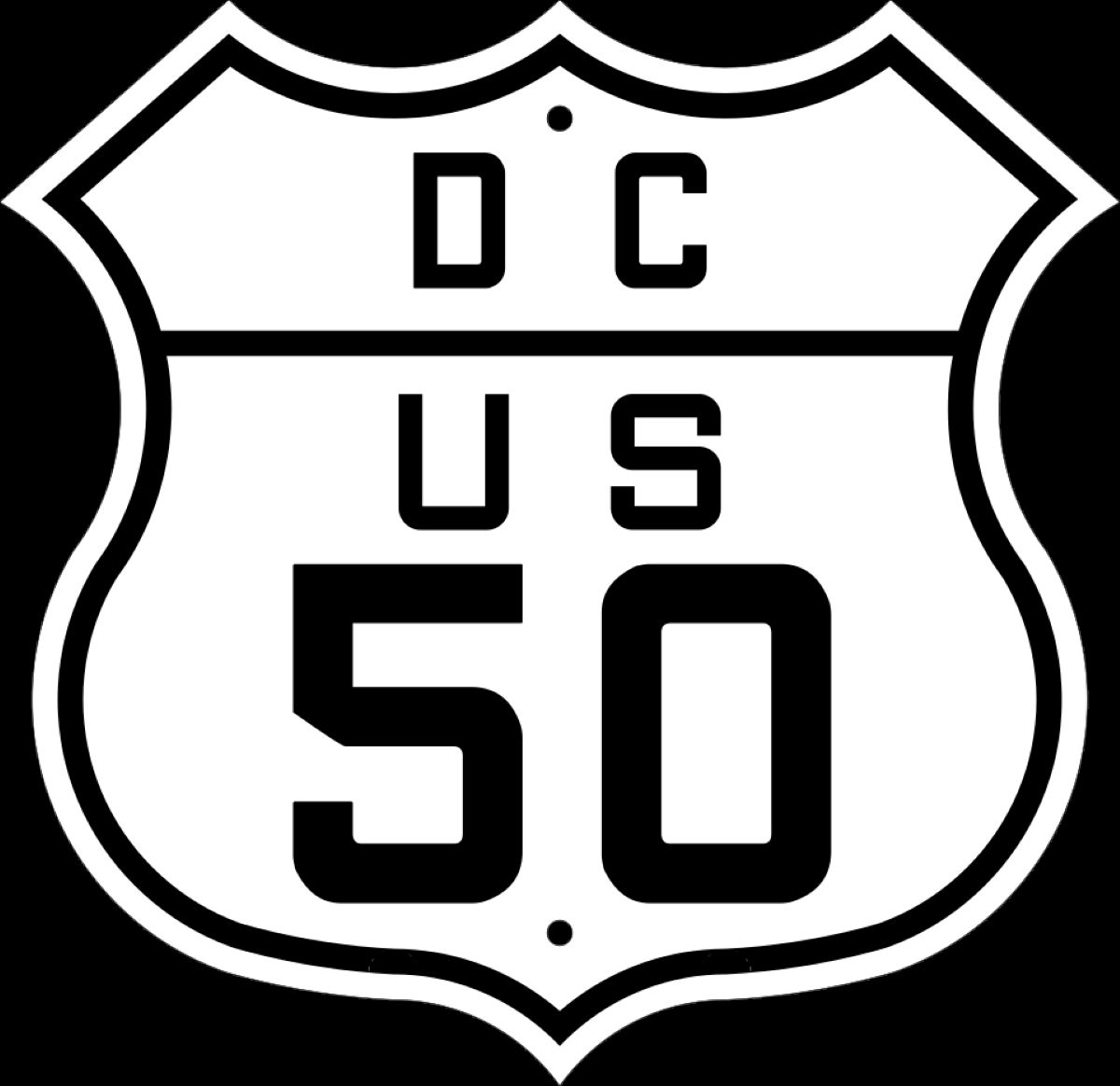
It would be an understatement to say that John C. Nicholson (1862-1942), a lawyer residing in the city of Newton, Kansas, was a big fan of highways. A longtime advocate for well-paved, high-quality roads, Nicholson ultimately focused much of his time and enthusiasm on promoting U.S. Route 50 (US 50). As president of the U.S. Highway 50 Association, he traveled nationwide with something akin to a missionary zeal to talk up this east-west highway and what he saw as its virtues.
The genesis of Nicholson’s overall love for highways was recounted in a September 1937 edition of the Kansas City Star. “Twenty-seven years ago, in 1910, John C. Nicholson, a lawyer of Newton, Kas., became interested in a movement for good roads,” stated this newspaper. “It was a series of accidents which made him road conscious. One of the early owners of an automobile, he found that the highways of Kansas in that day were little better than cowpaths.” This article went on to note, “The marking of highway routes and the improvement of good roads became a passion with him from that time on.”
That passion was very much in evidence when Nicholson visited Washington, D.C., during the fall of 1939, more than a dozen years after US 50 became one of the original routes of the United States Numbered Highway System. By the late 1930s, US 50 stretched across the country with Annapolis, Maryland, as the eastern terminus and San Francisco as the western terminus. Nicholson’s hometown of Newton was located at just about the midpoint between those cities.
Nicholson’s primary reason for going to Washington in 1939 was to visit his daughter Mary Morse Whitehead (1895-1975) and her husband U.S. Army Major (later U.S. Air Force Lieutenant General Ennis Clement Whitehead (1895-1964), who lived on Lowell Street in the northwest part of the nation’s capital. As the Washington-based Evening Star confirmed, however, Nicolson also spent his time in the city “touting his favorite hobby, highways in general and U.S. Route 50 in particular.” The headline for this article announced, “Road Booster Visits Capital, Highly Praising U.S. Route 50 – Highway Unequaled in U.S. for Scenery, Nicholson Says.”
Nicholson took time during his stay in Washington to meet with local lawyer Edward F. Colladay (1877-1961), president of the city’s division of the U.S. Highway 50 Association, to discuss various issues pertaining to the route. In addition, Nicholson lavished unstinting praise on US 50 in an interview with the Evening Star. “Washington should be proud to occupy such a point on old No. 50,” he asserted. “Why that’s the lifeblood artery of this country’s system of highways.”
Quite a few years earlier in the pursuit of his “favorite hobby,” Nicholson had expended his considerable energies into helping to develop and boost the north-south auto trail known as the Meridian Highway. (Newton was part of this highway.) After U.S. Route 81 (US 81) became another one of the original U.S. Numbered Highway System routes, it followed a great deal of what had been the Meridian Highway between North Dakota and Texas. Nicholson served as president of the U.S. 81 Highway Association but eventually retired from that role, as he explained during this Evening Star interview, so that he could instead devote his time to “good old No. 50.”
Since the U.S. Highway 50 Association was a non-profit organization, Nicholson acknowledged that he had to pay on his own for various expenses “but not any more than the average hobby costs a fellow.” He also claimed that he had driven across every inch of “old No. 50” and found the route to be the “most scenic highway” coast to coast. Nicholson also talked about visiting the New York World’s Fair prior to his arrival in Washington. During his time in the Empire State, he told people there that the best way to travel to the Pacific coast was to “go to Washington and hit old No. 50.”
Not everything that Nicholson said about this highway was complimentary, though. He called the segment of the route between Washington and Annapolis “the worst piece of road on the whole highway, from ocean to ocean,” a strong concern of his that he also directly conveyed to the Maryland State Roads Commission, Annapolis Chamber of Commerce, and Maryland division of the U.S. Highway 50 Association. (Nicholson also urged the state to extend its portion of US 50 to the state’s Eastern Shore, something that eventually did happen.)
Tragically, Nicholson died in 1942 after being struck by an automobile while visiting Colorado. He was 80. His obituary in the Kansas-based Evening Eagle noted, “He was one of the original road boosters and was known as the father of the Meridien Highway and at the time of his death was president of the Highway 50 association.”
US 50 now covers 3,019 miles (4,859 kilometers) altogether between West Sacramento, California, and Ocean City, Maryland. The total mileage of this route in Washington, D.C., is 7.7 miles (12.4 kilometers).
Image Credit: Public Domain
Additional information on John C. Nicholson is available at https://www.thc.texas.gov/public/upload/preserve/survey/highway/HistoricContext.pdf
For more information on U.S. Route 50 (US 50), please check out https://highways.dot.gov/highway-history/general-highway-history/part-4-named-trails-us-numbered-highways/part-e and https://route-50.com/the-origin-of-u-s-highway-50-and-other-matters/


Leave a Reply