A week after the fourth regional meeting of the Joint Board on Interstate Highways had taken place in Atlanta, the fifth of these meetings — likewise focused on potential U.S. Highway Numbered System routes — was held in New York City on June 15, 1925.
The previous day’s edition of the New York Times reported, “Highway officials of New York, New Jersey, Pennsylvania, Maryland and Delaware will meet in this city tomorrow to designate the important interstate roads in these five States which will be uniformly marked as United States highways.”
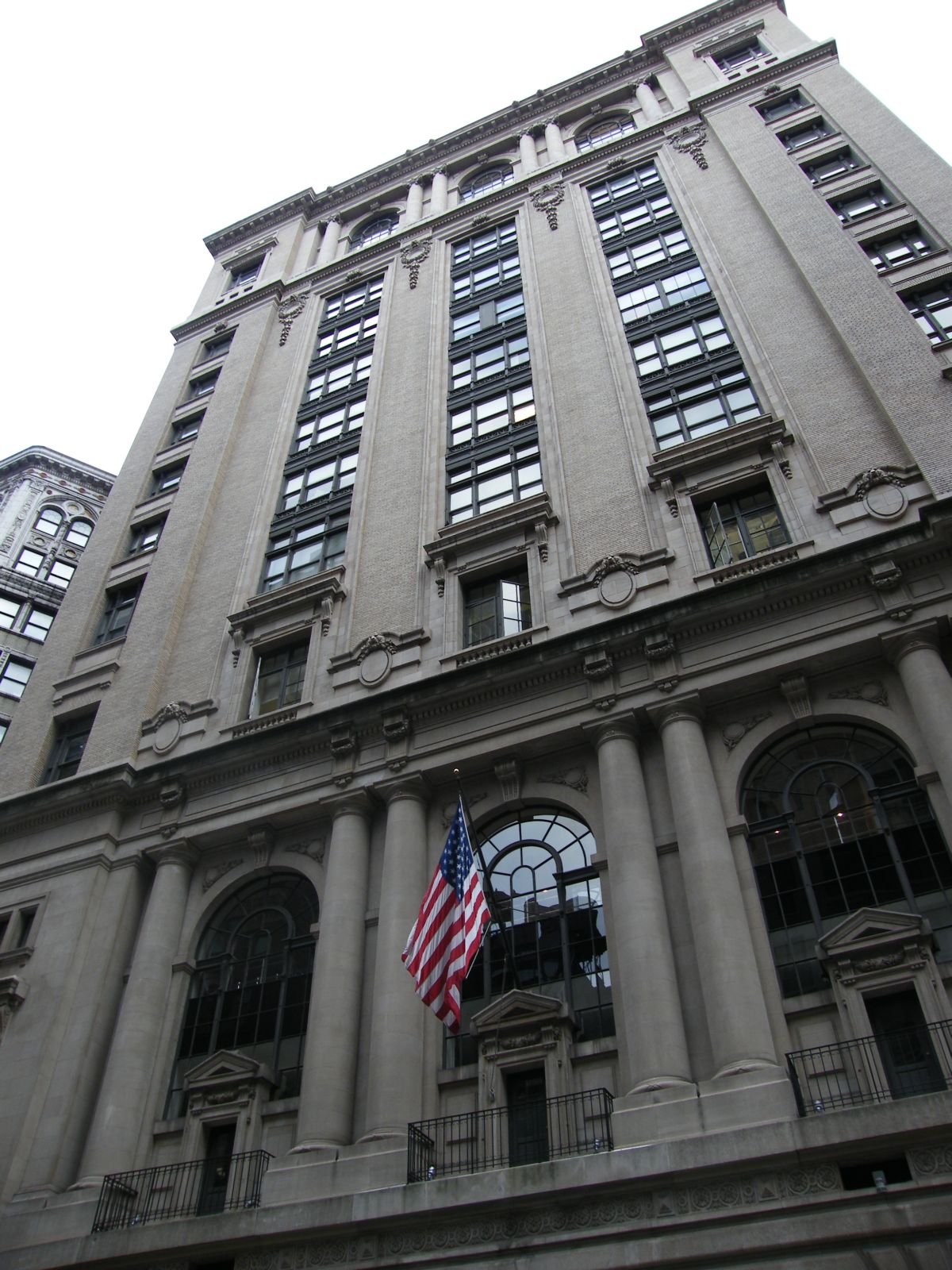
The venue for this meeting was the board room for the American Society of Civil Engineers (ASCE) in the Engineering Societies’ Building on West 39th Street in midtown Manhattan. This building had been constructed in 1907 as a shared clubhouse for the American Society of Mechanical Engineers, the American Institute of Mining Engineers, and the American Institute of Electrical Engineers. ASCE became part of this partnership in 1917.
The Engineering Societies’ Building, which was added to the National Register of Historic Places in 2007, is now owned by the international real estate and investment firm known as Thor Equities. The accompanying photo of this building was taken in 2008.
Of all the six regional meetings held by the Joint Board on Interstate Highways, the one in New York City turned out to be the most sparsely attended. Just two of the five states identified a day earlier by the New York Times were represented in person at this meeting. The only board members present were Edward Warley (E.W.) James (1877-1967), who served as both the chief of the Design Division of the U.S. Bureau of Public Roads and the board’s secretary; and Frederick Stuart Greene (1870-1938), the superintendent of public works for New York.
The only other people in attendance were present by invitation. They were Edward E. Reed (1884-1953), assistant highway engineer for the New Jersey State Highway Department; and Harry E. Neal (circa 1884-1954), traffic engineer for the Ohio State Highway Department. Neal was on hand to essentially pick up where his boss Lou A. Boulay (1878-1953), state highway director for Ohio, had left off at the regional meeting for the Great Lakes states in Chicago.
According to the board’s comprehensive report finalized that fall, “Mr. Neal of Ohio was present especially to complete unadjusted connections with Pennsylvania, which were left open by Mr. Boulay at the Chicago meeting, and these were made as far as they could be made by the group representatives without conference with Pennsylvania.”
At the time, nobody from Pennsylvania officially or at least directly clarified why this state did not send any representatives to the meeting in New York City. The report also noted that “correspondence from Delaware indicated their willingness to accept decisions of the Board,” and the explanation given by Maryland State Roads Commission chairman John N. Mackall (1885-1968) for his own state’s absence was likewise documented for the record. According to the report, “a personal conference with Mr. Mackall indicated that the principal roads through Maryland were so obvious that he thought it would be unnecessary for him to be present.”
Even with a notably small number of people in attendance, the meeting still had more than its lion’s share of strong concerns assessed and addressed. According to the board report, “A general examination of the field map as brought to this group meeting at once produced the impression that too many roads had been selected and Mr. Greene of New York was especially desirous of reducing the mileage and the layout in New York was made accordingly.”
The report further recounted, “Mr. Greene said he thought he would on his own initiative send a copy of his State map to the other States in order that they could more clearly get his idea of a desirable density of transcontinental routes. He felt that the whole system should be very carefully gone over by the Joint Board with a view to eliminating a large number of alternates, short cuts and cross roads, which could not fairly be considered as of transcontinental significance, or even of major interstate importance.”
As the report also confirmed, however, “Except for the general difference of attitude there was no lack of harmony at this meeting.” The next and final regional meeting occurred three days later in Boston.
Photo Credit: Americasroof at English Wikipedia (licensed under the Creative Commons Attribution-Share Alike 3.0 Unported license at https://creativecommons.org/licenses/by-sa/3.0/deed.en)
For more information on the regional meeting of the Joint Board on Interstate Highways in New York City, please check out https://en.wikisource.org/wiki/Report_of_Joint_Board_on_Interstate_Highways_October_30,_1925 and https://www.fhwa.dot.gov/infrastructure/numbers.cfm


Leave a Reply