October 29, 1927
In the Canadian province of Ontario, about 15,000 people turned out for the opening of a bridge in the Greater Toronto Area. This bridge, crossing the Don River, was built to serve as a link between the town of Leaside and the township of East York.
“The whole of the bridge is located is located in East York Township, with approximately 2,800 feet [853.4 meters] of its northern approach being in Leaside,” reported the Toronto Telegram on the day of the structure’s public debut. “The south end of the bridge connects with the north end of Pape ave. in [the neighboring settlement of Todmorden] and the bridge itself spans the valley of the Don River and connects with Millwood road in the Town of Leaside.”
(In 1967, East York and Leaside were amalgamated to form the Borough of East York. This borough, along with five other municipalities, was merged with the Municipality of Metropolitan Toronto in 1998 to become the present-day megacity of Toronto. Todmorden is now a Toronto neighborhood.)
Construction on the bridge began in January 1927. The Leaside Bridge – also known as the East York-Leaside Bridge – was designed by Canadian civil engineer James Franklin “Frank” Barber (1875-1946) in partnership with American architect Claude Fayette Bragdon (1866-1946). The Toronto Telegram highlighted the relatively quick turnaround in transforming the bridge from blueprints to reality.
This newspaper reported, “Completed thirty-two days ahead of schedule, the East York-Leaside Bridge and its contractors, Roger Miller & Sons, are in possession of a new world’s record for rapid construction of structures of its size, it being built in exactly 262 days – twelve days less than the former world’s record for a bridge of its size.”
The inaugural ceremonies for the Leaside Bridge were held on the 60th anniversary of when, as a crucial step in the process known as Canadian Confederation, the first senators of the federal dominion of the newly independent Canada were officially appointed. One of the various nicknames for the Leaside Bridge over the years, as a matter of fact, has been the Confederation Viaduct.
William Donald Ross (1869-1947), who had become lieutenant governor of Ontario in January of 1927 and would serve in the position until 1931, performed the ribbon-cutting duties for the formal opening of the Leaside Bridge. The Toronto Star reported, “Preceding the arrival of his honor, the pipe band of the Toronto Scottish Regiment, the band of the Mississauga Horse [a Canadian Militia cavalry regiment) and airplanes soaring overhead kept the immense throng which had gathered to witness the ceremonies in an enthusiastic mood.”
After arriving at the event, Ross proceeded to cut what the Toronto Star called the “silken barrier” on the Leaside Bridge. He also paid tribute to those who had been involved in the construction of this bridge. Ross asserted, “It is a magnificent piece of work, long to remain a monument to those who had the wisdom to complete it.”
The Toronto Star also noted the first horse-drawn and motorized vehicles to travel across the Leaside Bridge that afternoon. “The first bread wagon passed over the bridge at 4:22 p.m.,” reported the newspaper. “One of the T.T.C. [Toronto Transportation Commission] system of buses was the first motor vehicle passing over the viaduct after it had been declared open.”
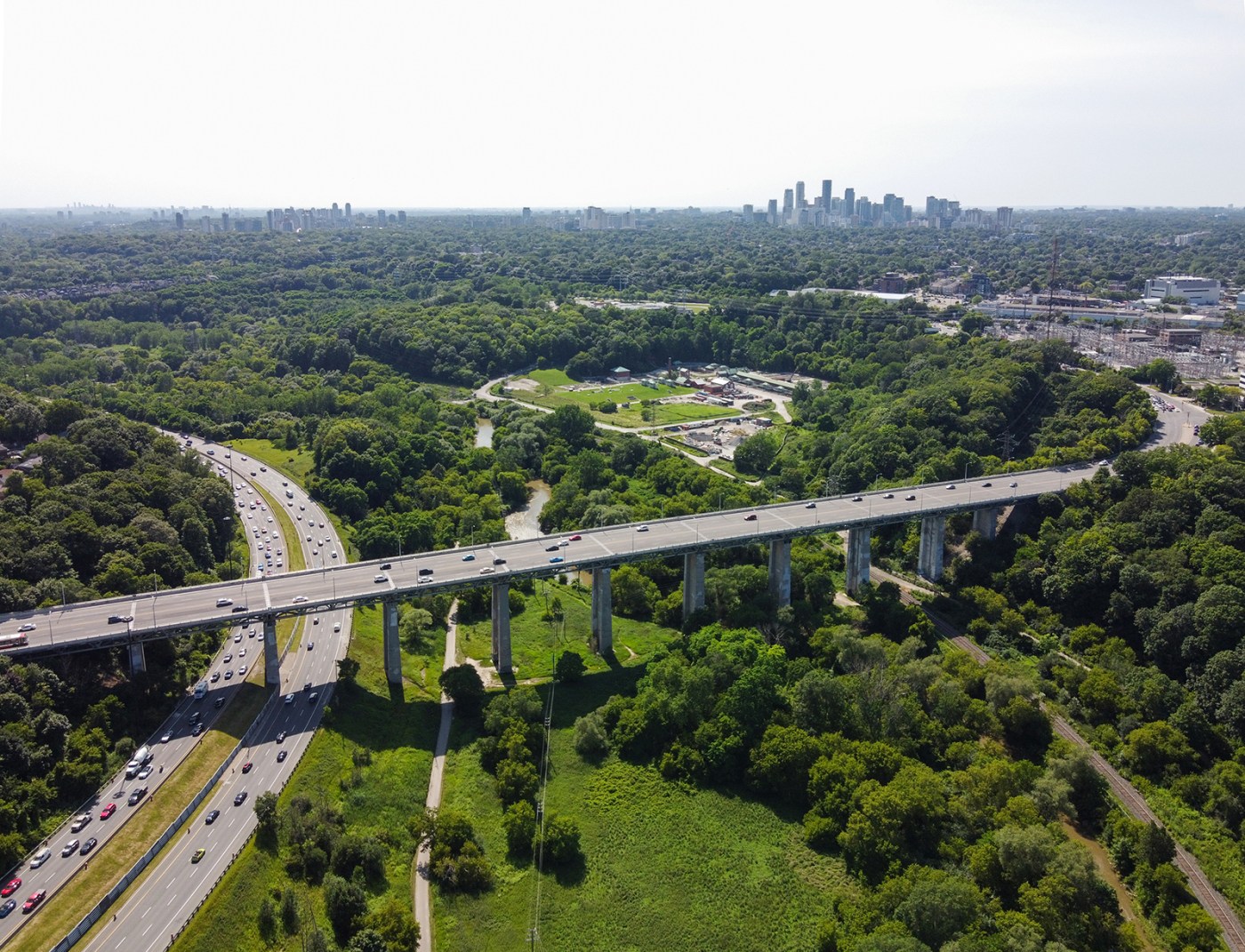
The Leaside Bridge, which was extensively renovated during both the late 1960s and mid-2000s, has a total length of 1,443 feet (440 meters). This truss bridge encompasses six lanes for vehicular traffic, two lanes for bicycles, and two sidewalks for pedestrians. The accompanying photo of the Leaside Bridge was taken in 2023.
Photo Credit: Canmenwalker (licensed under the Creative Commons Attribution 4.0 International license at https://creativecommons.org/licenses/by/4.0/deed.en)
For additional information on Canadian bridges, please check out https://en.wikipedia.org/wiki/List_of_bridges_in_Canada


Leave a Reply