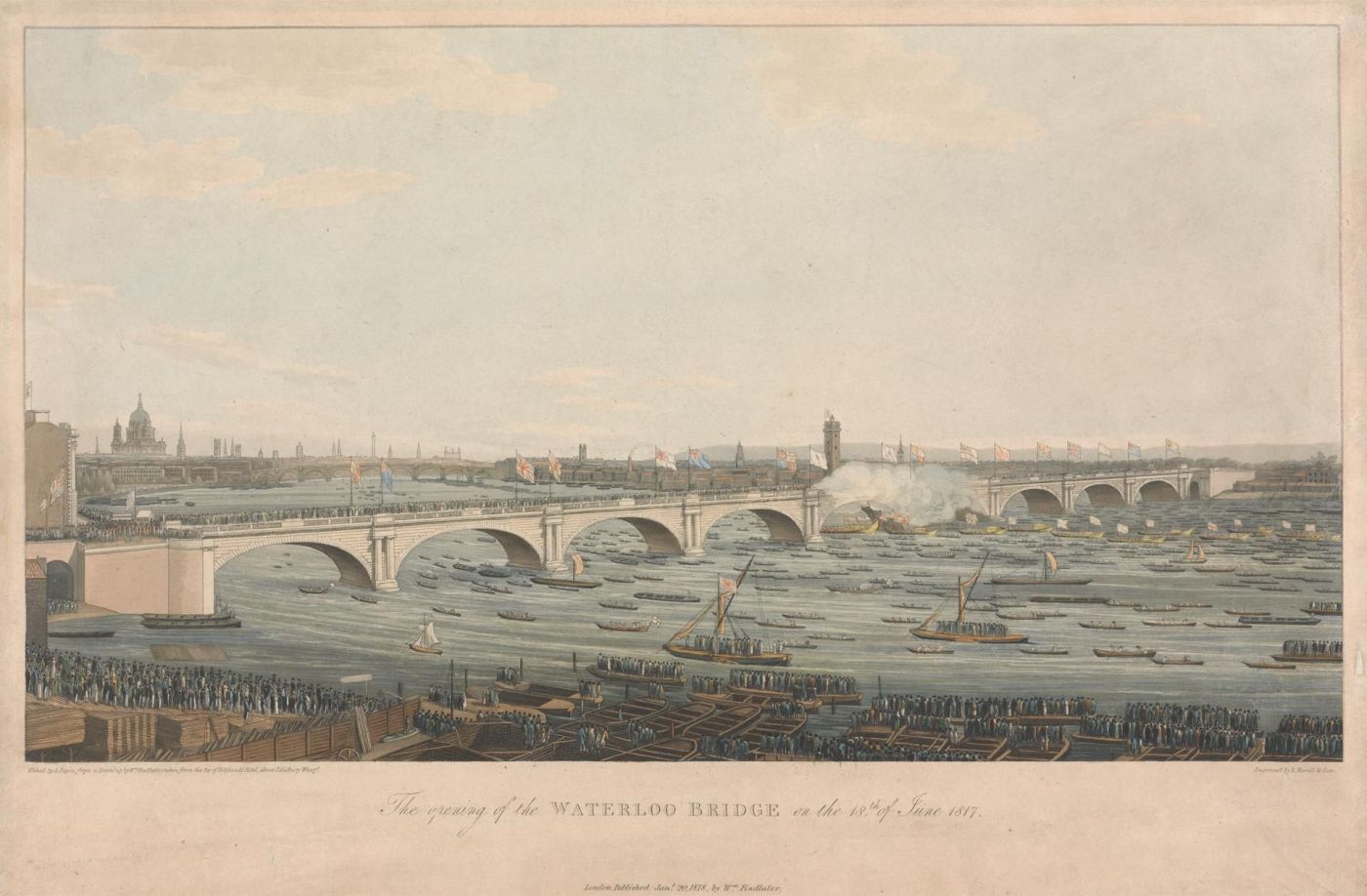
June 18, 1817
A granite bridge crossing the River Thames in London was formally opened by the Prince of Wales and future King George IV (1762-1830), who had assumed the role of Prince Regent and taken over the royal responsibilities of his incapacitated father King George III (1738-1820) six years earlier.
This bridge was built to carry horse-drawn carriages and carts as well as pedestrian traffic across that section of the river. Originally named Strand Bridge after a major street connected to it, the structure was redesignated as Waterloo Bridge to commemorate the battle in which British, Dutch, and Prussian troops decisively defeated Napoleon Bonaparte (1769-1821) and his French Imperial Army.
The inauguration of the Waterloo Bridge took place on the second anniversary of that historic victory. Arthur Wellesley, 1st Duke of Wellington (1769-1852) — one of the commanders who triumphed over Napoleon at Waterloo — walked alongside the Prince Regent on the bridge as part of the dedication ceremony for the new structure. The person accompanying them on this walk was the Prince Regent’s brother Prince Frederick, Duke of York and Albany (1763-1827), another son of George III and the commander-in-chief of the British Army. All three men led a procession that included various other dignitaries and military officers.
The next day’s edition of the London-based Times described all of the pomp and people that were abundantly in evidence during the festivities for the bridge’s grand debut. “This noble structure was opened yesterday for the public accommodation, with as much splendour and dignity as is possible for to give to a ceremony of this description,” recounted this newspaper.
The Time also stated, “The intended ceremony excited the public curiosity to a great extent yesterday forenoon, which was much incsreased by the remarkable fineness of the weather, alike favourable for standing on the bridge, viewing the procession from the banks, or making excursions on the river.”
Measuring 2,456 feet (748.6 meters) in length, the first version of Waterloo Bridge had nine arches altogether. Double Doric stone columns were installed between these arches. The prolific Scottish civil engineer John Rennie (1761-1821) designed the bridge, and quite a few people have considered it to be one of his architectural masterpieces. Italian sculptor and architect Antonio Canova (1757-1822), for example, called the structure “the noblest bridge in the world” and asserted that “it is worth going to England solely to see Rennie’s bridge.”
The accompanying image of the original Waterloo Bridge’s opening is a print created in 1818 by Augustus Charles Pugin (1762-1832). Other notable artists who memorialized this bridge in their own works include John Constable (1776-1837) and Claude Monet (1840-1926).
By the early 1930s, the bridge had fallen into such a state of disrepair that the London County Council decided to demolish it. The replacement for this structure is a 1,230-foot (370-meter) -long box girder bridge that still exists and likewise bears the name of Waterloo Bridge.
Image Credit: Public Domain
For more information on the original Waterloo Bridge, please check out https://www.londonmuseum.org.uk/collections/london-stories/waterloo-bridge/ and https://www.british-history.ac.uk/survey-london/vol23/pp23-24


Leave a Reply