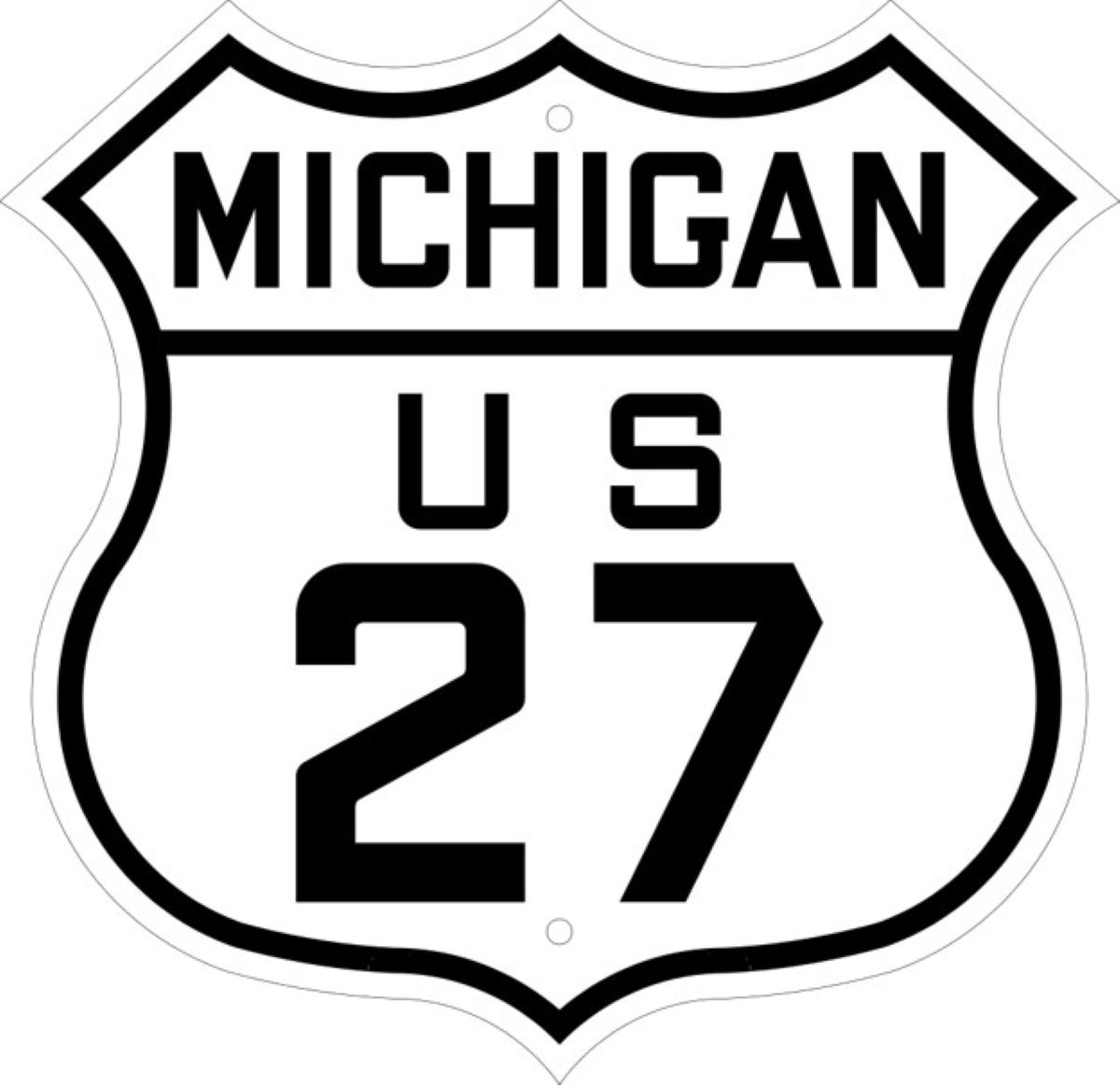
In April 1925, the first full-fledged meeting of the Joint Board on Interstate Highways was held at the headquarters of the U.S Bureau of Public Roads (BPR) in Washington, D.C. This two-day meeting took place just a few weeks after the board was formally established to work on developing what ultimately became the U.S. Numbered Highway System.
The board members met in the office of Thomas H. MacDonald (1881-1957) BPR’s chief and the board’s chairman. One of the key actions taken on that first day involved agreeing to postpone any discussion of numbers for the new highway system until actual routes had been identified. Another topic broached during the same session was the matter of an official shield for that network of highways and what should be included as part of that signage.
Board member Lou A. Boulay (1878-1953), director of Ohio highways and public works, recommended that such a marker for each highway within the system should feature both the initialism U.S.A. and the number assigned to that specific route. Boulay’s fellow board member Frank F. Rogers (1858-1942), state highway commissioner of Michigan and the incumbent president of the American Association of State Highway Officials (AASHO), called the proposal for a highway shield with a national theme “quite satisfactory.”
The entire board then approved Boulay’s motion to adopt “a uniform system of through route marking for the United States” and that “a uniform shape and type of route marker, to be adopted later, be selected for the marking of these routes through the different States.” The following day, the board further discussed the shield and what it should look like. Rogers asserted, “Each State should have the right to insert the name of the State in the upper part of the shield to be adopted.”
Edward Warley (E.W.) James (1877-1967), who wore two hats as the chief of BPR’s Division of Design and the board’s secretary, sat next to Rogers during this session of the meeting. James recalled many years later that, while everyone gathered there was talking about the design for the marker, Rogers “doodled and produced a sort of shield. He handed it to me. I think I improved on his design by drawing a picture of our present shield.” Edwards went on to recount, “He took it back, presented it to the board as just what was wanted, and that was that.”
This proposed version of the shield was unanimously approved, in the words of the meeting’s minutes, “as a tentative design.” The board subsequently approved MacDonald’s motion that copies of the design be sent to the states for review and comment.
The next full meeting of the board was held again at the BPR headquarters on August 3 and 4 of that year. On the second day of this meeting, the issue of the shield was once more front and center among those in attendance. James was the one who had sent copies of the design to the states. In reporting on the responses that he received, James said that the states indicated support for such a shield with very few if any significant recommended alterations. The board then made its final decision on the design that had been doodled by Rogers and revised by James.
The Associated Press (AP) reported from the nation’s capital, “The shield of the United States was adopted today as a model for the outline of route markers for the system of national highways being worked out by the joint board for interstate highways in session here.” AP also noted, “The shield will have a white background, with the name of the state, the initials ‘U.S.’ and the route number in black.”
Not long after BPR officially authorized the inaugural routes for the U.S. Numbered Highway System in January 1927, the Washington Post focused on this new network’s unique marker. “The United States shield with the distinguishing route numbers already has been erected as the standard road marker in twenty-two States,” reported the newspaper. “Twenty others will have the markers in place by the end of the 1927 touring season.” (The accompanying image depicts an example of one of these original U.S. route shields.)
The Washington Post further noted, “Every motorist who has taken a long journey knows the nervousness superinduced by the constantly recurring question, ‘Am I on the right road?’ Following the uniform markers of the United States System of Highways, he no longer will be disconcerted by his inability to reconcile the names of towns with the information given him or developed by him before he began his journey.”
Image Credit: Public Domain
For more information on the development and adoption of the U.S. Route shield, please check out https://www.fhwa.dot.gov/infrastructure/numbers.cfm#a8


Leave a comment