This is part of a series of posts commemorating the centennial of the United States Numbered Highway System.
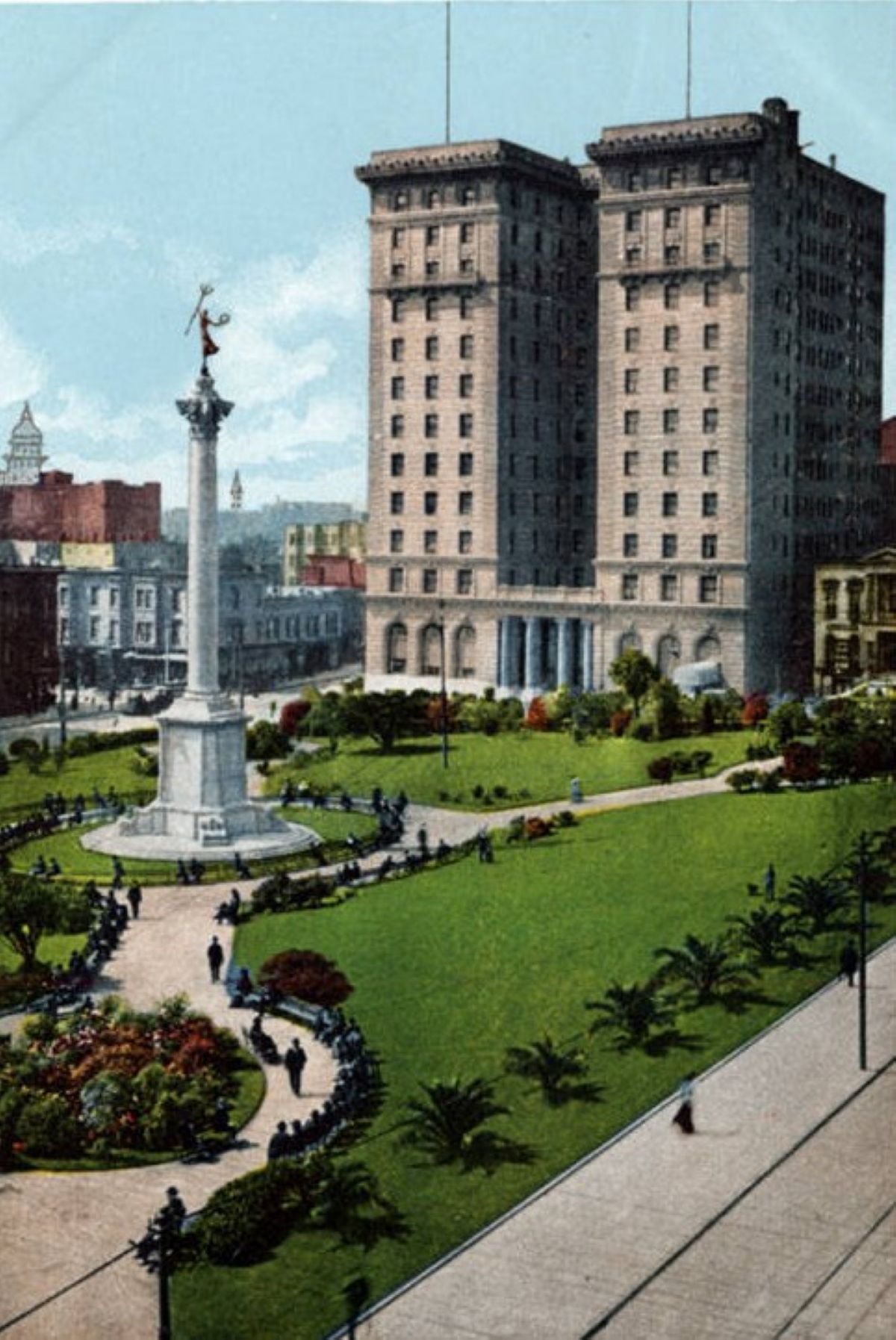
Less than a month before the 10th anniversary of the organization’s founding in Washington, D.C., the American Association of State Highway Officials (AASHO) held its 1924 annual meeting in San Francisco. This meeting specifically took place in November at the Hotel St. Francis in the downtown part of the city. This hotel, which is now known as the Westin St. Francis, was built in 1904. The accompanying image of the hotel is a postcard that was created just a few years after its opening by the Detroit Publishing Company.
By the time that AASHO delegates gathered for the annual meeting in 1924, the association had already accomplished a great deal when it came to establishing a crucial federal-state partnership for the construction and maintenance of roads nationwide. The gathering in San Francisco would mark yet another milestone in these efforts due to a stronger-than-before advocacy for the development of a uniform numbered highway system throughout the United States.
Wisconsin had already served as pioneer for this type of system several years earlier when it became the first state to replace trail signs with numbers. A 1917 state law in Wisconsin required the creation of a state trunk highway system of up to 5,000 miles (8,046 kilometers). This law included a provision requiring uniform guide and warning signs for that statewide system.
A few of the other states followed Wisconsin’s example, but with the continued promotion of the booster associations, the named trails retained their popularity. Indeed, the names were commonly used by all concerned, including the U.S. Bureau of Public Roads (BPR), the American Association of State Highway Officials (AASHO), newspapers, map and guidebook companies, and the public. The names often lingered even in states that adopted numbers. Iowa began numbering its highways in 1920, for example, but this State continued to register named trails under the authority of a 1913 law designed to protect the trail names that had been developed by the communities.
By the 1920s, highway officials realized that named trails had outlived their usefulness even as their numbers continued to swell. The federal-aid highway program, begun in 1916, had entered a “golden age” when the Federal-Aid Highway Act of 1921 limited federal-aid highway funding to a federal-aid system comprising seven percent of each state’s road network; three-sevenths of Federal-aid highway mileage had to be “interstate in character.”
With the state and federal governments identifying the main roads for the federal-aid system, completed in 1923, and providing funds on a 50-50 basis to surface thousands of miles of these roads, the need for private organizations to promote individual routes was diminishing.
As a result of the rapidly increasing volume of registered motor vehicles traffic across the country, the now-urgent need for numbered highways to safely and reliably accommodate as well as guide all that traffic took center stage at the AASHO meeting in San Francisco. The stage for this was set there with a report that was submitted on November 18 by the association’s Subcommittee on Traffic and Control of Traffic to the AASHO Committee on Administration.
This report was signed by Edward Warley (E.W.) James (1877-1967), who was both the subcommittee’s temporary chairman and the chief of BPR’s Division of Design. The report noted, “There has long been more or less coherent expression of public opinion in favor of the designation of certain routes across our country in different directions by a single well-known name or designation, and it is recognized that the organizations which have drawn wide and considerable support from almost every section of the United States.”
The report submitted by James further asserted, “The Federal Aid Highway system, provided for in law, has been designated and approved for all of the States, and consequently conditions are such at the present time that your [subcommittee] strongly feels that the Association should take a definite stand for a general designation of through routes. Such action will involve administrative cooperation on the part of all States and probably legislative action on the part oa number, and it is obvious, therefore, that any action to be effective and reasonably rapid must be had under the direction of some one properly equipped rather than under any one State.”
Two days later, AASHO’s delegates at the meeting approved a resolution calling on the U.S. Secretary of Agriculture (USDA was the “umbrella” department for BPR) to work with the states “ to undertake immediately the selection and designation of a comprehensive system of through interstate routes and to devise a comprehensive and uniform scheme for designating such routes in such a manner as to give them a conspicuous place among the highways of the country as roads of interstate and national significance.”
The final paragraph in this resolution consisted of the following statement: “To more satisfactorily carry out these suggestions and obtain speedy and satisfactory results, this Association requests the Secretary of Agriculture to appoint a joint board to be composed of members of the Bureau of Public Roads and of the State highway departments to cooperate in formulating and promulgating a system of numbering and marking highways of interstate character.”
This joint board became a reality on March 2 of the following year, when USDA secretary Howard M. Gore (1877-1947) – based on recommendations from AASHO – appointed the members of this board. Thomas H. MacDonald (1881-1957), BPR’s Chief, was named chairman of the Joint Board of Interstate Highways. E.W. James was appointed to serve as the board’s secretary and Austin B. Fletcher (1872-1928), BPR’s consulting highway engineer, became the agency’s third representative.
The membership of the Joint Board of Interstate Highways also encompassed a total of 21 state highway officials collectively representing each region of the country. These officials included Frank F. Rogers (1858-1942), state highway commissioner of Michigan, who had been elected AASHO’s 10th president in San Francisco. The establishment of this board opened a new and tough-to-predict chapter for the development of what became the U.S. Numbered Highway System.
Image Credit: Public Domain
For more information on the 1924 AASHO Annual Meeting and its impact on the U.S. Numbered Highway System, please check out https://www.fhwa.dot.gov/infrastructure/numbers.cfm


Leave a Reply