July 8, 1916
With momentum continuing to take firm shape across the United States for the Federal Aid Road Act of 1916, International News Service (INS) issued an update on this landmark legislation. “The new bill proposing federal aid to road building has gone to President Wilson for his signature,” reported INS. Along with providing the latest status on that bill just over a week after it had been passed by both the U.S. Senate and House of Representatives, the INS story also focused on how one member of the Kansas congressional delegation – Joseph Taggart (1867-1938) — viewed the proposed legislation.
“Representative Joseph Taggart, who was an enthusiastic supporter of the act, declared today that it was one of the most important measures that could be devised for the agriculturists of this county,” reported INS. “Its main object . . . is to promote agriculture by affording better facilities for rural transportation and marketing farm products, by the development of a general system of improved highways.”
Three days after the release of this story, President Woodrow Wilson (1856-1924) finally signed the Federal Aid Road Act into law at noon in a White House ceremony. “I take a great deal of pleasure in signing this bill and having a part in the good work that has been done, particularly because it tends to thread the various parts of the country together,” said Wilson in his remarks during the ceremony.
Those who witnessed the bill signing included congressional lawmakers as well as representatives from the American Association of State Highway Officials (AASHO), American Automobile Association (AAA), and farmers’ organizations. The gold pen used by Wilson for signing the bill was given to Amos Grant Batchelder (1868-1921), AAA’s executive chairman. AASHO, which had been formally established just over a year-and-a-half earlier in the nation’s capital, played a key role along with AAA in championing the Federal Aid Road Act of 1916 and helping to make it a reality.
The Federal Aid Road Act of 1916 apportioned funds for highways based on area, population, and post road mileage. According to the law’s provisions, the federal share of funding would be 50 percent of the actual cost (up to $10,000 a mile). These funds, however, were available only to states that had both highway agencies in existence and legislatures that formally consented to the act’s provisions. In these ways and others, the Federal Aid Road Act of 1916 set the stage for today’s U.S. highway system and subsequent measures that have likewise supported and strengthened that national network.
Taggart’s role as “an enthusiastic supporter” of the pioneering federal-aid bill did not end with Wilson signing it into law. As the Kansas-based Ottawa Herald reported about a month later, the Democratic congressman strongly emphasized what his home state still had to do in order to become eligible for federal funds under the new law. “Mr. Taggart believes the next Kansas legislature should pass certain legislation to empower the state to come under the terms of this law without question,” according to the Ottawa Herald. “One thing needed is a highway department.”
The state legislature took that step in 1917 when it passed a bill, which was signed into law by Governor Arthur Capper (1865-1951), creating the Kansas State Highway Commission to serve as a clearinghouse for federal money. The commission’s first secretary-director was William Colfax Markham (1868-1961), who went on to serve as the first executive secretary of AASHO from 1923 to 1942.
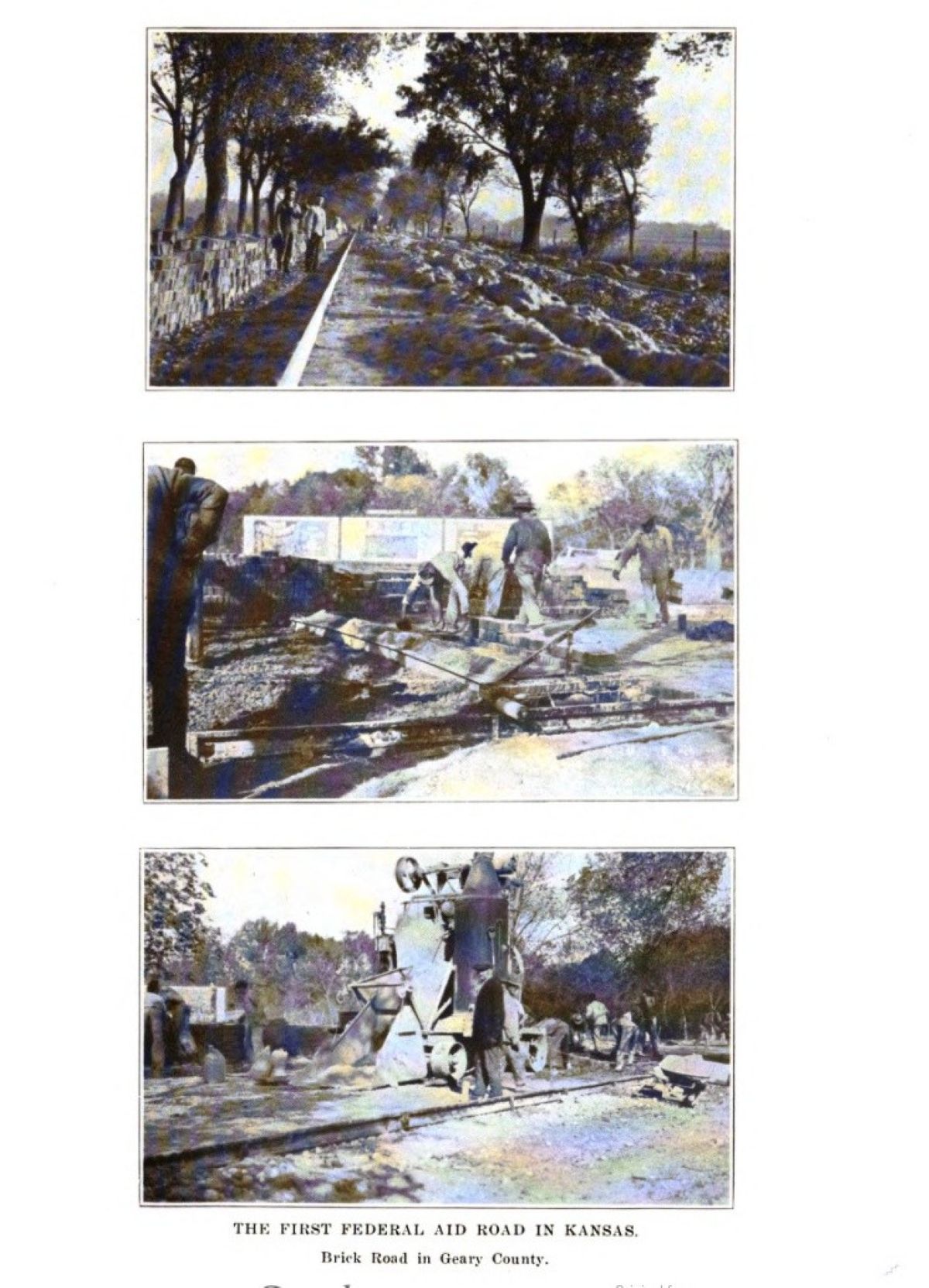
The accompanying photos were included in the Kansas Highway Commission’s first biennial report, which was published in 1919. These images feature a road in Geary County in the east-central region of the Sunflower State and the work performed on that route under the provisions of the Federal Aid Road Act of 1916.
Attribution for photos: First Biennial Report of the Kansas Highway Commission – April 4, 1917 to January 1, 1919
For more information on the Federal Aid Road Act of 1916, please check out https://www.fhwa.dot.gov/highwayhistory/landmark.pdf and https://www.govinfo.gov/content/pkg/SERIALSET-06953_00_00-056-0548-0000/pdf/SERIALSET-06953_00_00-056-0548-0000.pdf


Leave a Reply