June 22, 1950
The Highway Research Board (the present-day Transportation Research Board) formally announced the imminent launch of a major highway research project in the Washington, D.C. metropolitan area. This project would specifically take place in the vicinity of La Plata, a Maryland town about 32 miles (51.5 kilometers) southeast of the nation’s capital.
The project was known as Road Test One-MD and implemented to further assess the service life of highway pavements and the impact of wheel loads. A special committee of the Interregional Council on Highway Transportation, a 15-state group focused on uniformity in truck weights, proposed that road test.
The council took shape in 1949, with Ohio highway director Theodore J. Kauer (1904-1983) named its chairman and Maryland traffic division director George N. Lewis Jr. (1906-1981) selected to serve as secretary. The special committee issuing the proposal for Road Test One-MD did so while meeting in Baltimore in January 1950.
Road Test One-MD was subsequently administered and supervised by the Highway Research Board (HRB) through both its Project Executive Committee and Advisory Committee. Fred Burggraf (1897-1966), HRB associate director, chaired each of these committees. (He became director of HRB in 1951 and would remain in this position until retiring in 1964.)
Eleven of the states belonging to the Council on Highway Transportation joined the District of Columbia in financing Road Test One-MD. Those states were Connecticut, Delaware, Illinois, Kentucky, Maryland, Michigan, New Jersey, Ohio, Pennsylvania, Virginia, and Wisconsin. Asriel Taragin (1915-1990) of the U.S. Bureau of Public Roads (a predecessor of the Federal Highway Administration) became the project engineer for this road test.
Road Test One-MD in fact began the day after HRB’s official announcement about the initiative and would continue until December 23 of that year. These tests occurred on a blocked-off area of U.S. Route 301 (US 301) that was located approximately nine miles (14.5 kilometers) south of La Plata. This 1.1-mile (1.8 -kilometer) section of Portland cement was created in 1941.
The American Association of State Highway Officials (AASHO) – now known as the American Association of State Highway and Transportation Officials (AASHTO) – reported on the initial stage of Road Test One-MD in the association’s longtime magazine American Highways.
This article noted that the tests “will compare the effects of concentrated truck traffic of various axle loads on one type of concrete pavement.” This article then specified, “Two pairs of single axle trucks loaded to 18,000 and 22,400 pounds [8,164.7 and 10,160.5 kilograms] respectively and two pairs of tandem axle trucks loaded to 32,000 and 44,800 pounds [14,515 and 20,320.9 kilograms] started around-the-clock operations.”
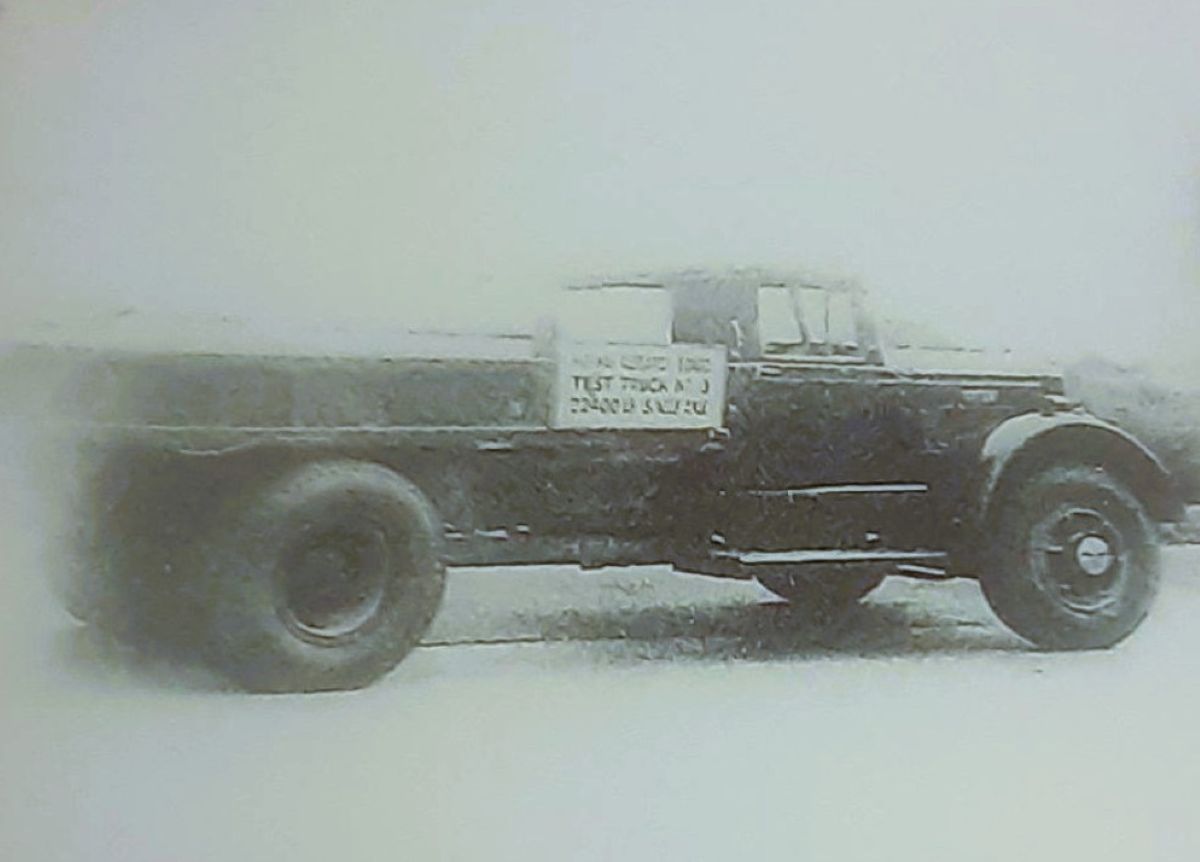
As AASHO also confirmed, the truck manufacturers providing the vehicles for the project were the Autocar Company; Ford Motor Company; General Motors Corporation; International Harvester Company; Mack International Motor Truck Company; Reo Motors, Inc; and White Motor Company. (One of these test trucks is featured in the accompanying photo.) The gasoline, oil, and grease for the trucks were supplied by American; Atlantic; Cities Service; Esso Standard of New Jersey; Gulf; Ohio; Phillips; Pure; Shell; Sinclair; Socony Vacuum; Sun; Texas; and Tidewater.
About a dozen days before the end of those merry-go-round tests, the Associated Press (AP) provided an update on what had been happening non-stop on that heavily traveled portion of US 301 since late June. AP succinctly noted, “For nearly six months, trucks of varying weights have been shuttling 24 hours a day, 7 days a week, in allotted lanes over a stretch of guinea pig highway in Southern Maryland.”
In March of the following year, Burggraf was among the featured speakers at a conference held at Purdue University in Indiana. In discussing the results of Road Test One-MD, he also cited a pioneering series of road tests from three decades earlier in Illinois. These tests took place on a two-mile (3.2-kilometer) segment of road built by the Illinois Department of Highways on state property near the community of Bates in the central part of the state. The experiments conducted on that segment became collectively known as the Bates Road Test.
“Great changes have taken place since then in the field of highway transportation,” said Burggraf, “but research on the effect of truck axle loads on pavement continued to lag behind that of the rapidly growing trucking industry.” It was then that he invoked a deceased but still world-renowned scientist to draw a direct connection between that road test and the more recent one in Maryland.
Burggraff asserted, “Sir Isaac Newton [1643-1727] once said that in case of a disagreement about facts, the matter ‘is to be decided but by new trial of the experiment.’ Road Test One-MD, the ‘new trial of experiment,’ was conceived to provide some of the much needed information.” During the remainder of his presentation, Burggraff made the case that the six-month research efforts near La Plata did indeed go a long way in widening and deepening knowledge about the effects of truck traffic on concrete pavements.
These efforts were subsequently pursued in other venues throughout the rest of the decade and some more years beyond that. In 1953-54, the Western Association of State Highway Officials sponsored a road test in Idaho. This project, which HRB administered as well, focused on the impact of heavy truck traffic on flexible (asphalt) pavements A total of 11 states sponsored the project. Those states were California, Colorado, Idaho, Montana, Nevada, New Mexico, Oregon, Texas, Utah, Washington, and Wyoming.
An even more comprehensive experimental effort took place with the AASHO Road Test between 1958 and 1960 in Illinois. AASHO sponsored this series of tests, each of which HRB supervised. The AASHO Road Test took place along a seven-mile (11.3-kilometer) track of two-lane highway between the cities of Ottawa and LaSalle.
For more information on Road Test One-MD, please check out


Leave a Reply